Year 11 (ages 15–16, Grade 10 in the US) · Geography · GCSE human geography · Lesson 2
A city in a newly emerging economy: Rio de Janeiro
A case study of Rio de Janeiro in Brazil: its location and importance, the opportunities urban growth brings, the challenges of squatter settlements (favelas), and how urban planning has tried to improve life for the urban poor.
Exam boards: this lesson matches the AQA GCSE geography courses. Check which course your school follows.
8-minute video lesson
Teaching, worked examples and 20 practice questions solved step by step.
Watch free for a monthWhat your child will learn
- Describe the location and importance of Rio de Janeiro
- Explain opportunities created by urban growth
- Explain challenges in favelas
- Evaluate an urban planning scheme
The method
- Location: south-east Brazil, on the Atlantic coast.
- Opportunities: jobs, services, culture, industry.
- Challenges: favelas, poor sanitation, crime, traffic, pollution.
- Planning: favela improvement schemes — upgrading rather than demolishing.
Key words: newly emerging economy, favela, informal economy, squatter settlement, self-help scheme.
Worked examples
Worked examples from the lesson, with every step.
Question 1
Describe the location of Rio de Janeiro.
- Step 1: Brazil, South America.
- Step 2: South-east coast, on the Atlantic Ocean.
Answer: on the Atlantic coast of south-east Brazil
Question 2
Why is Rio important nationally?
- Step 1: Major port and centre for finance and tourism.
- Step 2: Hosts major events and festivals.
Answer: economic, tourist and cultural centre
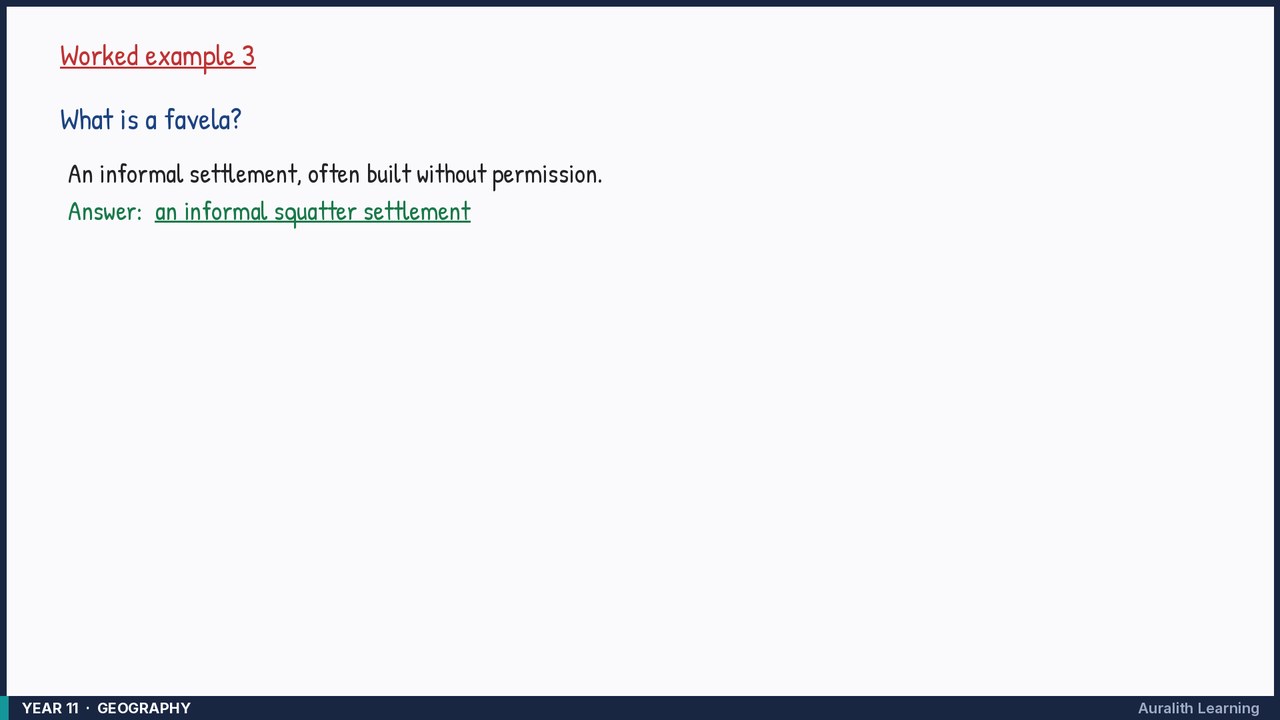
Question 3
What is a favela?
- Step 1: An informal settlement, often built without permission.
Answer: an informal squatter settlement