Year 11 (ages 15–16, Grade 10 in the US) · Citizenship · Power, politics and the constitution · Lesson 1
The UK constitution and the role of the monarch
How the UK's uncodified constitution works, the principles of parliamentary sovereignty, the rule of law and the separation of powers, and the role of the monarch in a constitutional monarchy.
Exam boards: this lesson matches the AQA and Pearson Edexcel GCSE citizenship courses. Check which course your school follows.
8-minute video lesson
Teaching, worked examples and 20 practice questions solved step by step.
Watch free for a monthWhat your child will learn
- Explain what a constitution is
- Describe the sources of the UK constitution
- Explain key constitutional principles
- Describe the role of a constitutional monarch
The method
- A constitution sets out how a country is governed.
- The UK's is uncodified: not in one single document.
- Key principles: parliamentary sovereignty, rule of law, separation of powers.
- The monarch reigns but does not rule: a mostly ceremonial role.
Key words: constitution, uncodified, parliamentary sovereignty, rule of law, constitutional monarchy.
Worked examples
Worked examples from the lesson, with every step.
Question 1
What is the difference between a codified and an uncodified constitution?
- Step 1: Written in one document.
- Step 2: Spread across many sources.
Answer: one document versus many sources
Question 2
Give two sources of the UK constitution.
- Step 1: Acts of Parliament.
- Step 2: Unwritten rules.
Answer: statute law and conventions
Question 3
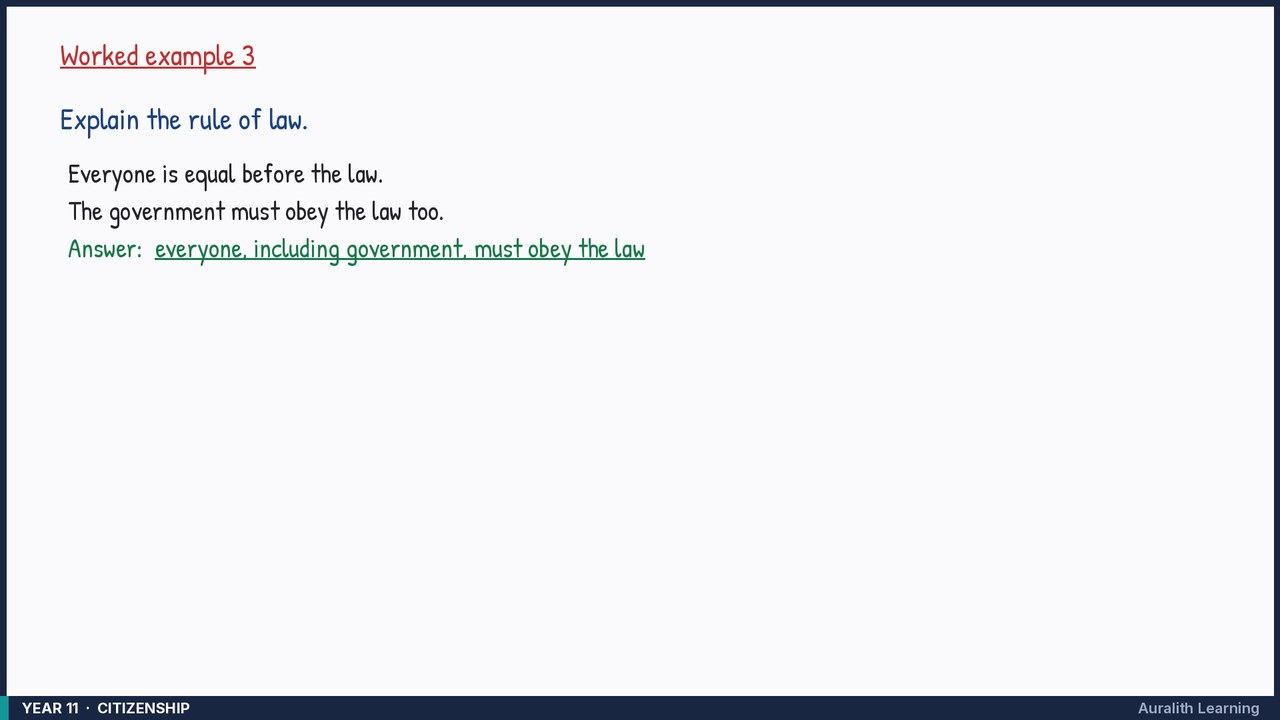
Explain the rule of law.
- Step 1: Everyone is equal before the law.
- Step 2: The government must obey the law too.
Answer: everyone, including government, must obey the law