Year 11 (ages 15–16, Grade 10 in the US) · Citizenship · Power, politics and the constitution · Lesson 2
Parliament and government: how laws are made
The roles of the House of Commons, the House of Lords and the monarch in Parliament, the difference between Parliament and government, how a bill becomes law, and how Parliament holds the government to account.
Exam boards: this lesson matches the AQA and Pearson Edexcel GCSE citizenship courses. Check which course your school follows.
8-minute video lesson
Teaching, worked examples and 20 practice questions solved step by step.
Watch free for a monthWhat your child will learn
- Describe the parts of Parliament
- Distinguish Parliament from government
- Explain how a bill becomes law
- Explain how Parliament scrutinises government
The method
- Parliament: House of Commons, House of Lords and the monarch.
- Government: the Prime Minister, Cabinet and ministers.
- A bill passes stages in both Houses, then gets Royal Assent.
- Scrutiny: questions, select committees, debates and votes.
Key words: House of Commons, House of Lords, bill, Royal Assent, scrutiny.
Worked examples
Worked examples from the lesson, with every step.
Question 1
How many MPs are in the House of Commons?
- Step 1: One per constituency.
Answer: 650
Question 2
What is the difference between Parliament and government?
- Step 1: Makes laws and scrutinises.
- Step 2: Runs the country and proposes policy.
Answer: Parliament legislates and scrutinises; government governs
Question 3
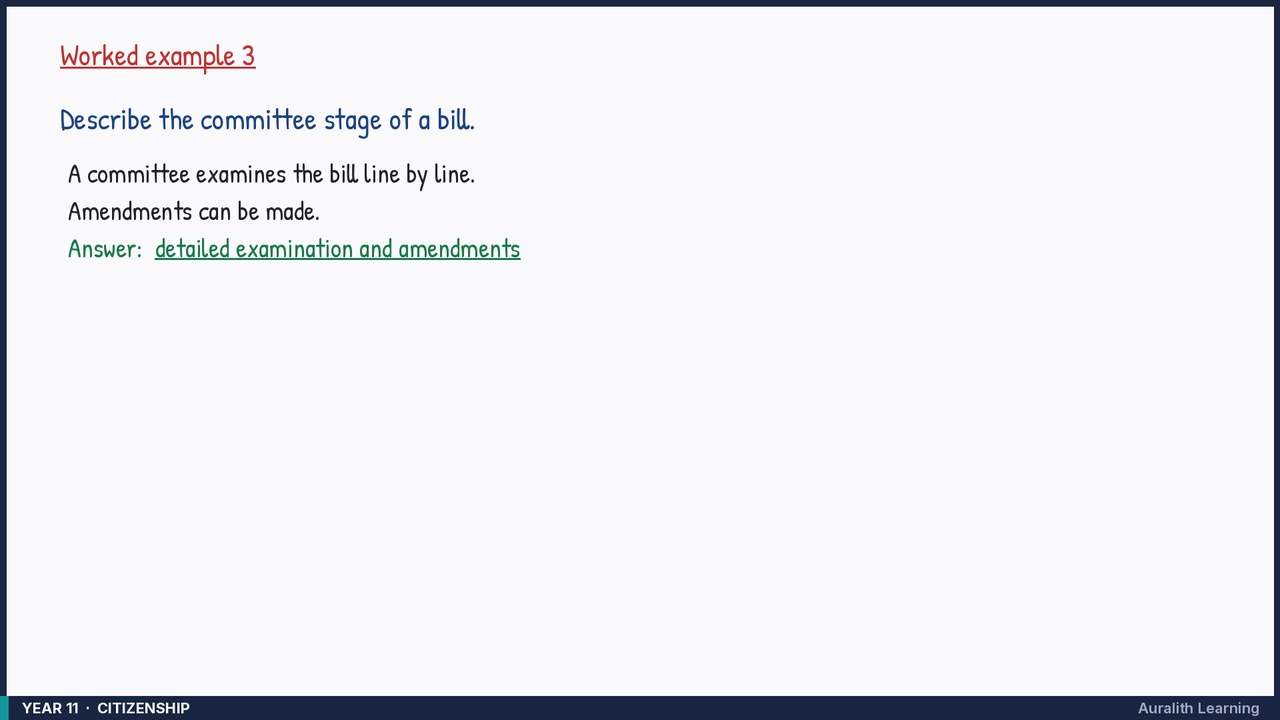
Describe the committee stage of a bill.
- Step 1: A committee examines the bill line by line.
- Step 2: Amendments can be made.
Answer: detailed examination and amendments