Year 10 (ages 14–15, Grade 9 in the US) · Science · Biology: cells and control · Lesson 3
The nervous system and reflexes
How the nervous system carries electrical impulses: receptors, sensory, relay and motor neurones, effectors, synapses and the reflex arc, plus the main parts of the brain.
Exam boards: this lesson matches the AQA and Pearson Edexcel GCSE science courses. Check which course your school follows.
8-minute video lesson
Teaching, worked examples and 20 practice questions solved step by step.
Watch free for a monthWhat your child will learn
- Describe the structure of a neurone
- Explain how a synapse works
- Describe a reflex arc
- Name parts of the brain and their functions
The method
- Stimulus → receptor → sensory neurone → CNS → motor neurone → effector → response.
- At a synapse, chemicals carry the signal across the gap.
- Reflexes are fast and automatic; they skip conscious thought.
- Brain: cerebrum, cerebellum, medulla.
Key words: neurone, synapse, neurotransmitter, reflex arc, effector.
Worked examples
Worked examples from the lesson, with every step.
Question 1
Put in order: motor neurone, receptor, effector, sensory neurone, CNS.
- Step 1: The receptor detects the stimulus.
- Step 2: receptor → sensory → CNS → motor → effector
Answer: receptor, sensory neurone, CNS, motor neurone, effector
Question 2
What is the effector when you pull your hand from a hot plate?
- Step 1: Effectors are muscles or glands.
- Step 2: A muscle in the arm contracts.
Answer: the arm muscle
Question 3
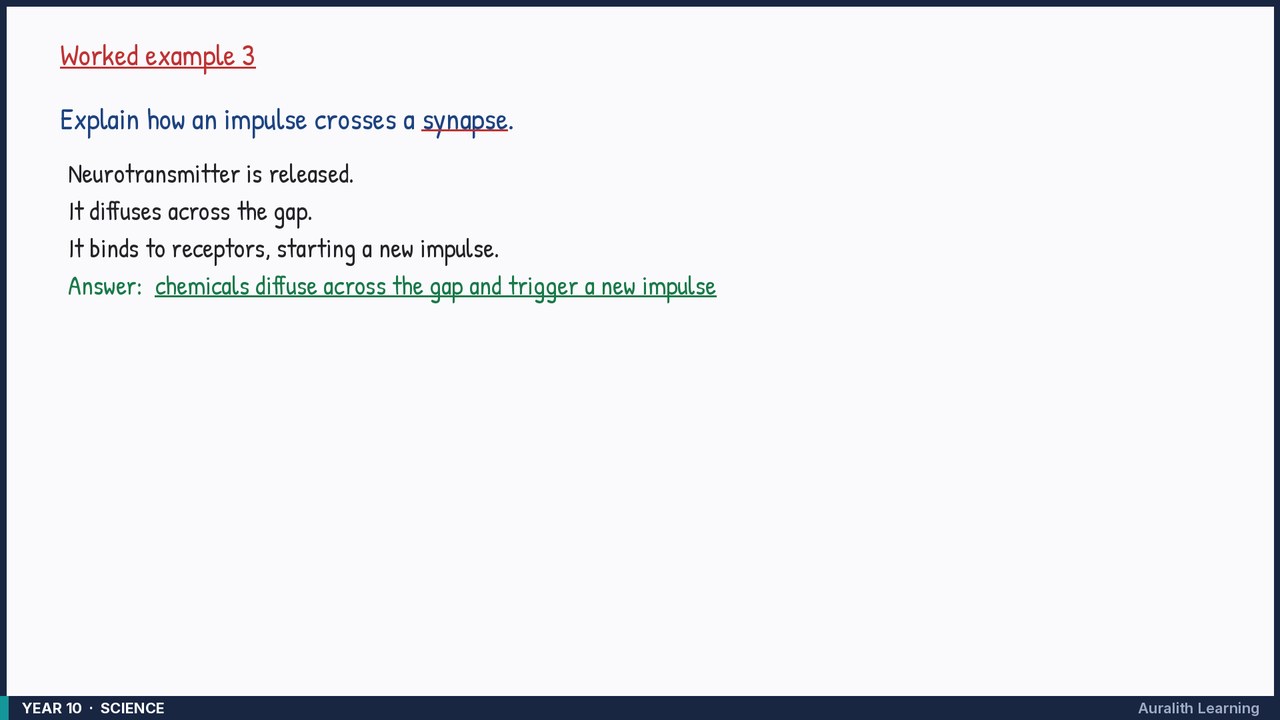
Explain how an impulse crosses a synapse.
- Step 1: Neurotransmitter is released.
- Step 2: It diffuses across the gap.
- Step 3: It binds to receptors, starting a new impulse.
Answer: chemicals diffuse across the gap and trigger a new impulse