Year 10 (ages 14–15, Grade 9 in the US) · Science · Biology: cells and control · Lesson 2
Growth, differentiation and stem cells
How animals and plants grow, what differentiation is, how to read percentile growth charts, and the uses, benefits and risks of embryonic, adult and plant stem cells.
Exam boards: this lesson matches the AQA and Pearson Edexcel GCSE science courses. Check which course your school follows.
9-minute video lesson
Teaching, worked examples and 20 practice questions solved step by step.
Watch free for a monthWhat your child will learn
- Describe growth in animals and plants
- Explain differentiation
- Read a percentile chart
- Evaluate the use of stem cells
The method
- Animals grow by cell division and differentiation.
- Plants also grow by cell elongation, at meristems.
- Percentile: the % of people below that value.
- Stem cells: where they come from, what they can become, risks.
Key words: differentiation, stem cell, meristem, percentile, elongation.
Worked examples
Worked examples from the lesson, with every step.
Question 1
Name the process where a cell becomes specialised.
- Step 1: It gains new structures for a job.
- Step 2: Differentiation.
Answer: differentiation
Question 2
Name one way plants grow that animals do not.
- Step 1: Both divide and differentiate.
- Step 2: Plant cells also get longer.
Answer: cell elongation
Question 3
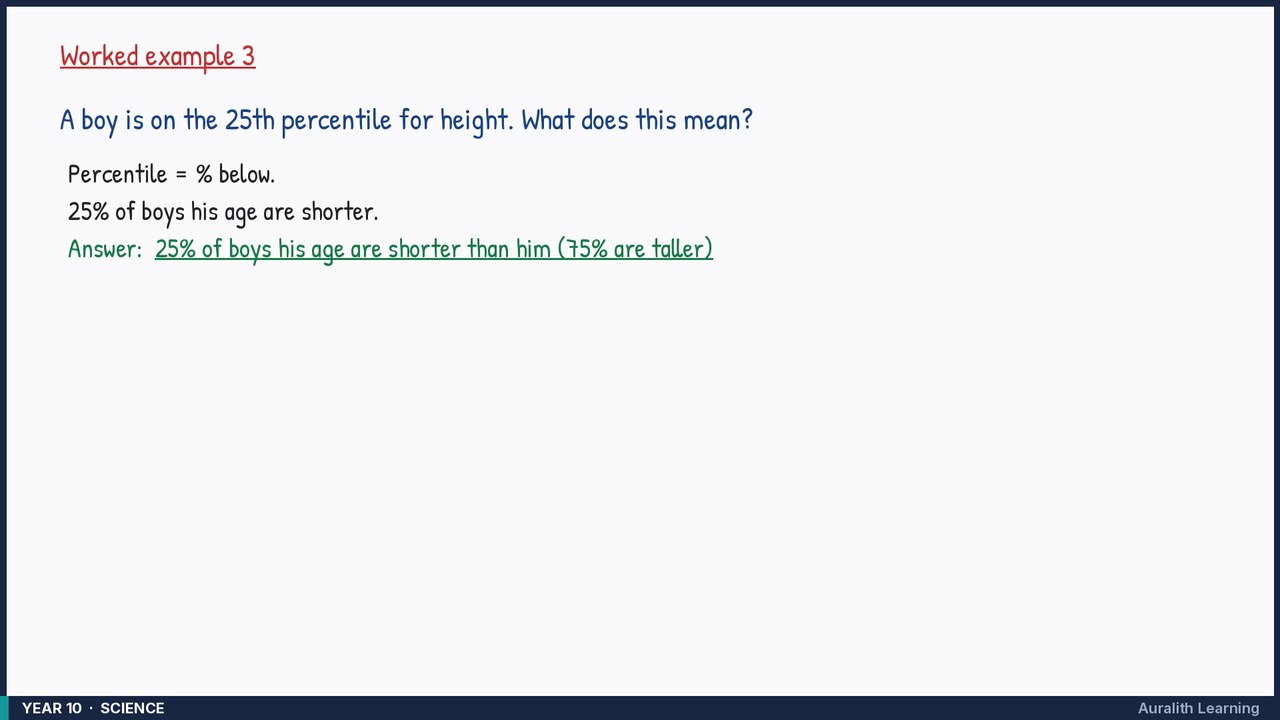
A boy is on the 25th percentile for height. What does this mean?
- Step 1: Percentile = % below.
- Step 2: 25% of boys his age are shorter.
Answer: 25% of boys his age are shorter than him (75% are taller)