Year 10 (ages 14–15, Grade 9 in the US) · Science · Biology: cells and control · Lesson 1
Mitosis and the cell cycle
The stages of the cell cycle and mitosis, why mitosis produces two genetically identical diploid cells, its role in growth, repair and asexual reproduction, and how uncontrolled division causes cancer.
Exam boards: this lesson matches the AQA and Pearson Edexcel GCSE science courses. Check which course your school follows.
8-minute video lesson
Teaching, worked examples and 20 practice questions solved step by step.
Watch free for a monthWhat your child will learn
- Describe the stages of the cell cycle
- Name the stages of mitosis
- Explain the uses of mitosis
- Link uncontrolled division to cancer
The method
- Interphase: the cell grows and copies its DNA.
- Mitosis: prophase, metaphase, anaphase, telophase.
- Cytokinesis: the cytoplasm divides.
- Result: two identical diploid cells.
Key words: mitosis, interphase, diploid, chromosome, cancer.
Worked examples
Worked examples from the lesson, with every step.
Question 1
What happens to DNA during interphase?
- Step 1: The cell prepares to divide.
- Step 2: It is copied (replicated).
Answer: the DNA is copied
Question 2
Put these in order: anaphase, prophase, telophase, metaphase.
- Step 1: PMAT.
- Step 2: Prophase, metaphase, anaphase, telophase.
Answer: prophase, metaphase, anaphase, telophase
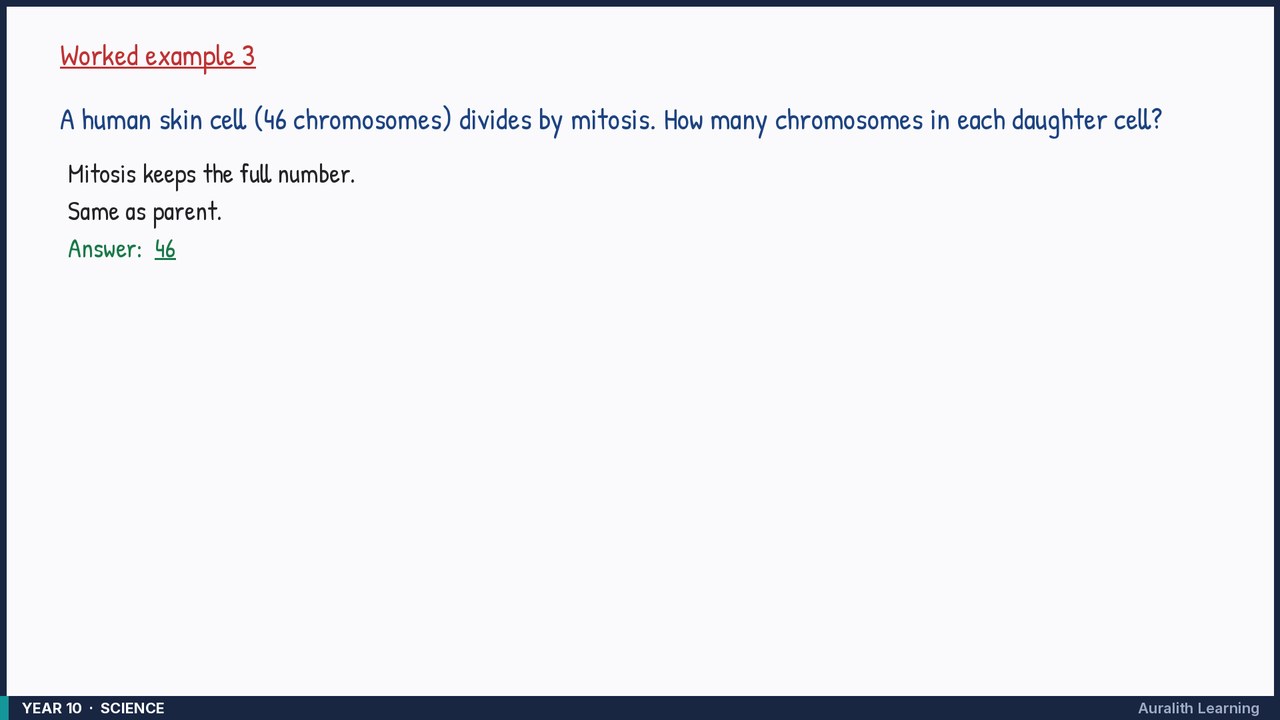
Question 3
A human skin cell (46 chromosomes) divides by mitosis. How many chromosomes in each daughter cell?
- Step 1: Mitosis keeps the full number.
- Step 2: Same as parent.
Answer: 46