Year 10 (ages 14–15, Grade 9 in the US) · Science · Chemistry: bonding and structure · Lesson 3
Structure and properties
How structure explains properties: giant ionic lattices, simple molecular substances and giant covalent structures (diamond and graphite), including melting points, conductivity and solubility.
Exam boards: this lesson matches the AQA and Pearson Edexcel GCSE science courses. Check which course your school follows.
9-minute video lesson
Teaching, worked examples and 20 practice questions solved step by step.
Watch free for a monthWhat your child will learn
- Describe giant ionic, simple molecular and giant covalent structures
- Explain melting and boiling points
- Explain electrical conductivity
- Compare diamond and graphite
The method
- Identify the structure.
- Melting point: what must break? Strong bonds or weak forces?
- Conductivity: are there charged particles free to move?
- Link each property to the structure.
Key words: lattice, intermolecular forces, giant covalent, delocalised, conductivity.
Worked examples
Worked examples from the lesson, with every step.
Question 1
Explain why sodium chloride has a high melting point.
- Step 1: Giant ionic lattice.
- Step 2: Many strong electrostatic attractions.
- Step 3: Lots of energy needed to break them.
Answer: many strong forces between ions need lots of energy to break
Question 2
Explain why methane is a gas at room temperature.
- Step 1: Simple molecules.
- Step 2: Weak intermolecular forces.
- Step 3: Little energy needed to separate.
Answer: weak intermolecular forces give a very low boiling point
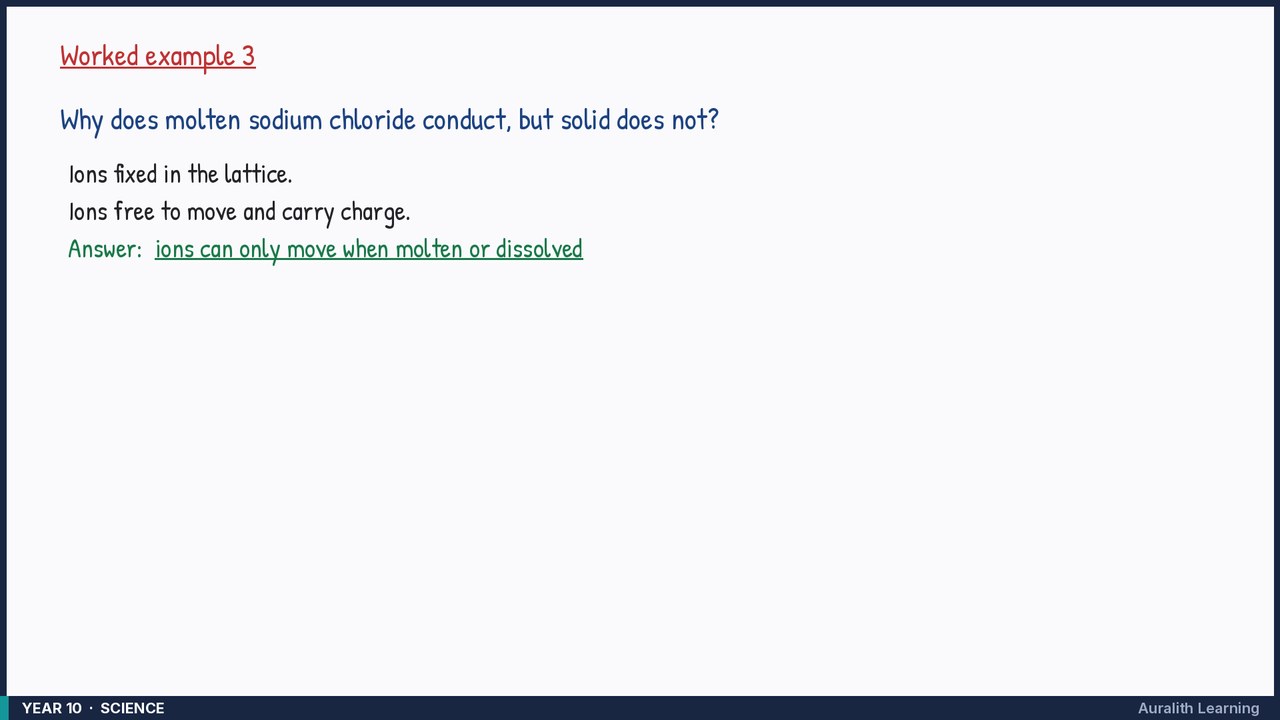
Question 3
Why does molten sodium chloride conduct, but solid does not?
- Step 1: Ions fixed in the lattice.
- Step 2: Ions free to move and carry charge.
Answer: ions can only move when molten or dissolved