Year 10 (ages 14–15, Grade 9 in the US) · Science · Chemistry: bonding and structure · Lesson 2
Covalent bonding
How non-metal atoms share pairs of electrons to form covalent bonds, dot-and-cross diagrams for hydrogen, chlorine, water, methane, oxygen and carbon dioxide, and single and double bonds.
Exam boards: this lesson matches the AQA and Pearson Edexcel GCSE science courses. Check which course your school follows.
8-minute video lesson
Teaching, worked examples and 20 practice questions solved step by step.
Watch free for a monthWhat your child will learn
- Explain what a covalent bond is
- Draw dot-and-cross diagrams for simple molecules
- Identify single and double bonds
- Work out how many bonds an atom forms
The method
- Covalent bonds form between non-metal atoms.
- Each bond is a shared pair of electrons.
- Atoms share until their outer shells are full.
- Bonds per atom: H 1, O 2, N 3, C 4.
Key words: covalent bond, shared pair, molecule, double bond, dot and cross.
Worked examples
Worked examples from the lesson, with every step.
Question 1
How many covalent bonds does a chlorine atom (2.8.7) form?
- Step 1: 1 more electron for a full shell.
- Step 2: 1 shared pair.
Answer: 1
Question 2
Describe the bonding in hydrogen chloride, HCl.
- Step 1: H needs 1; Cl needs 1.
- Step 2: They share one pair.
Answer: one single covalent bond (one shared pair)
Question 3
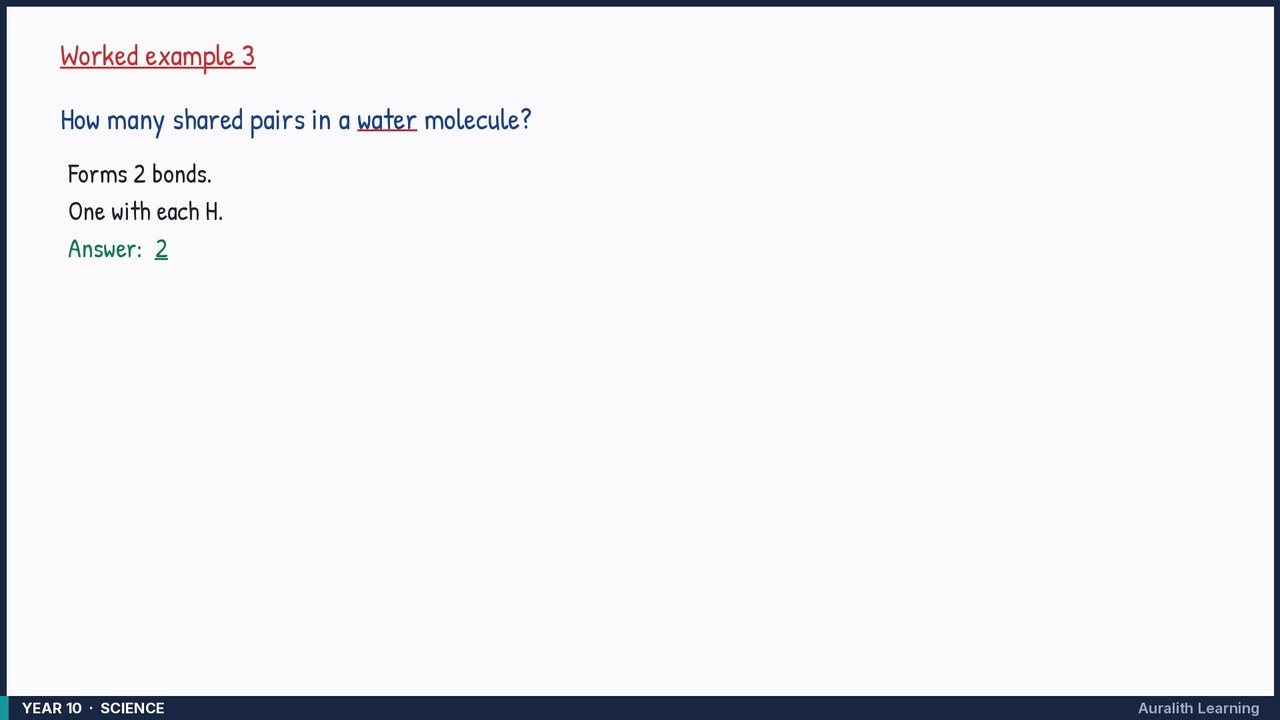
How many shared pairs in a water molecule?
- Step 1: Forms 2 bonds.
- Step 2: One with each H.
Answer: 2