Year 10 (ages 14–15, Grade 9 in the US) · Science · Chemistry: bonding and structure · Lesson 1
Ionic bonding
How metal and non-metal atoms transfer electrons to form ions, dot-and-cross diagrams for ionic compounds, working out ion charges from the group, and writing formulae of ionic compounds.
Exam boards: this lesson matches the AQA and Pearson Edexcel GCSE science courses. Check which course your school follows.
8-minute video lesson
Teaching, worked examples and 20 practice questions solved step by step.
Watch free for a monthWhat your child will learn
- Explain how ions form
- Work out ion charges from group number
- Draw dot-and-cross diagrams for ionic compounds
- Write formulae of ionic compounds
The method
- Metals lose electrons → positive ions.
- Non-metals gain electrons → negative ions.
- Group 1: +1, Group 2: +2, Group 6: −2, Group 7: −1.
- Balance charges to write the formula.
Key words: ion, cation, anion, ionic bond, electrostatic.
Worked examples
Worked examples from the lesson, with every step.
Question 1
What ion does potassium (Group 1) form?
- Step 1: Group 1: loses 1 electron.
- Step 2: +1
Answer: K⁺
Question 2
What ion does sulfur (Group 6) form?
- Step 1: Group 6: gains 2 electrons.
- Step 2: −2
Answer: S²⁻
Question 3
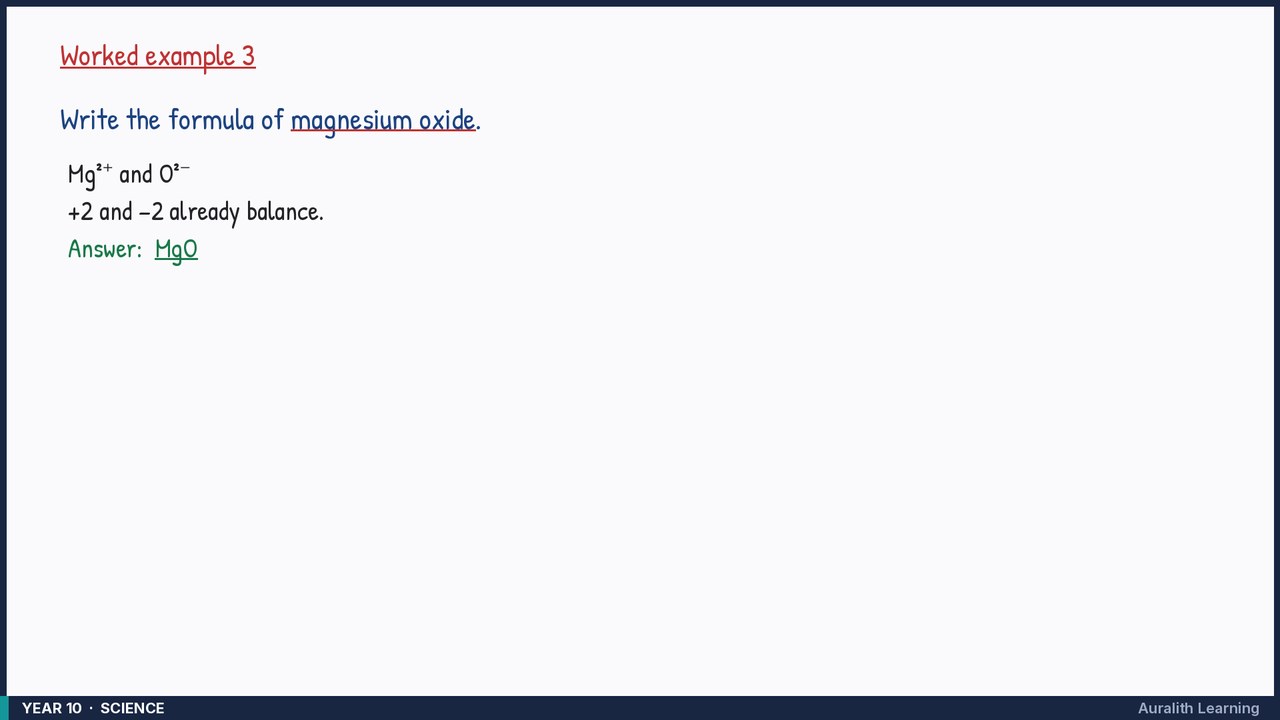
Write the formula of magnesium oxide.
- Step 1: Mg²⁺ and O²⁻
- Step 2: +2 and −2 already balance.
Answer: MgO