Year 10 (ages 14–15, Grade 9 in the US) · Science · Biology: natural selection and genetic modification · Lesson 3
Selective breeding and genetic engineering
How humans change organisms by selective breeding and by genetic engineering, the steps of inserting a gene using enzymes and vectors, and the benefits and risks of each technique.
Exam boards: this lesson matches the AQA and Pearson Edexcel GCSE science courses. Check which course your school follows.
9-minute video lesson
Teaching, worked examples and 20 practice questions solved step by step.
Watch free for a monthWhat your child will learn
- Describe the steps of selective breeding
- Describe how a gene is transferred
- Give examples of genetically modified organisms
- Evaluate benefits and risks
The method
- Selective breeding: choose, breed, select, repeat.
- Genetic engineering: cut gene out, insert into vector, transfer.
- Enzymes: restriction enzymes cut; ligase joins.
- Always weigh benefits against risks.
Key words: selective breeding, genetic engineering, restriction enzyme, ligase, vector.
Worked examples
Worked examples from the lesson, with every step.
Question 1
A farmer wants sheep with more wool. Describe how to use selective breeding.
- Step 1: Pick sheep with the most wool.
- Step 2: Breed them; select the woolliest lambs.
- Step 3: Repeat for many generations.
Answer: choose, breed, select, repeat over generations
Question 2
What do restriction enzymes do?
- Step 1: Cut DNA at specific sequences.
- Step 2: Leave sticky ends.
Answer: cut DNA at specific points, leaving sticky ends
Question 3
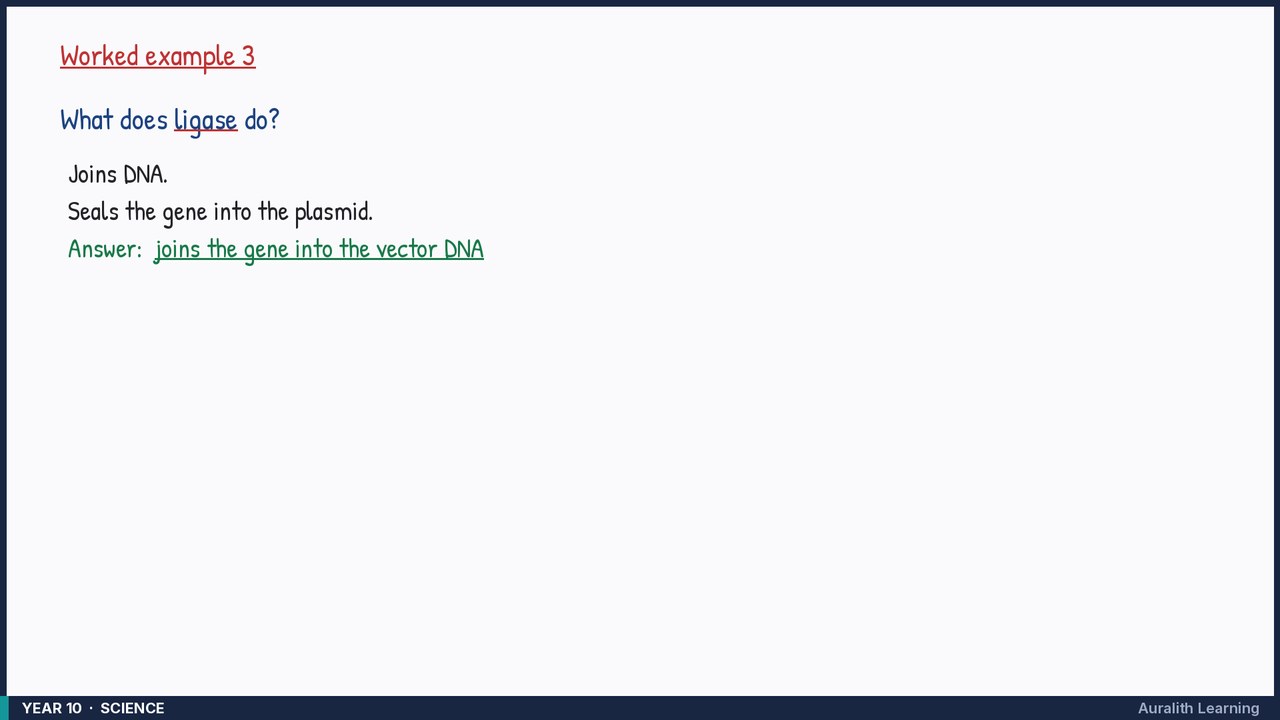
What does ligase do?
- Step 1: Joins DNA.
- Step 2: Seals the gene into the plasmid.
Answer: joins the gene into the vector DNA