Year 10 (ages 14–15, Grade 9 in the US) · Science · Biology: natural selection and genetic modification · Lesson 1
Natural selection and evolution
Darwin's theory of evolution by natural selection step by step, how mutations create new variation, and antibiotic-resistant bacteria as evidence of evolution happening now.
Exam boards: this lesson matches the AQA and Pearson Edexcel GCSE science courses. Check which course your school follows.
9-minute video lesson
Teaching, worked examples and 20 practice questions solved step by step.
Watch free for a monthWhat your child will learn
- Explain natural selection in steps
- Link mutation to variation
- Explain antibiotic resistance
- Use the key vocabulary accurately
The method
- Variation exists (often from mutation).
- Competition: not all survive.
- Best-adapted survive and reproduce.
- They pass on their alleles; over generations the population changes.
Key words: natural selection, variation, mutation, adaptation, resistance.
Worked examples
Worked examples from the lesson, with every step.
Question 1
What causes variation within a species?
- Step 1: Mutations and sexual reproduction.
- Step 2: Also diet, climate, lifestyle.
Answer: genes (mutation and sexual reproduction) and the environment
Question 2
Rabbits with thicker fur live in a cold area. Explain how thick fur became common.
- Step 1: Some rabbits had thicker fur.
- Step 2: They survived the cold better.
- Step 3: They bred and passed on the allele.
Answer: thick-furred rabbits survived and reproduced more, so the allele spread
Question 3
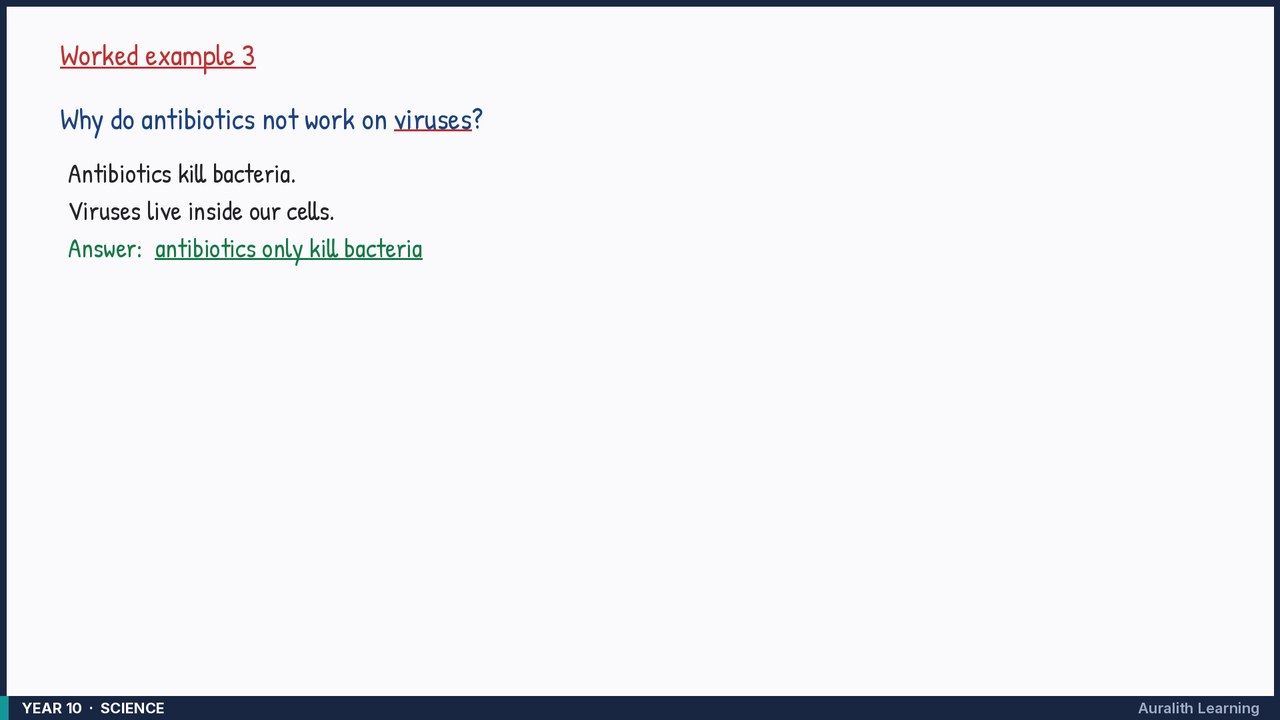
Why do antibiotics not work on viruses?
- Step 1: Antibiotics kill bacteria.
- Step 2: Viruses live inside our cells.
Answer: antibiotics only kill bacteria