Year 10 (ages 14–15, Grade 9 in the US) · Science · Biology: key concepts · Lesson 2
Microscopy and magnification
Light and electron microscopes, magnification and resolution, the magnification equation, converting between mm, µm and nm, and using standard form for tiny sizes.
Exam boards: this lesson matches the AQA and Pearson Edexcel GCSE science courses. Check which course your school follows.
10-minute video lesson
Teaching, worked examples and 20 practice questions solved step by step.
Watch free for a monthWhat your child will learn
- Compare light and electron microscopes
- Use magnification = image size ÷ real size
- Convert between mm, µm and nm
- Write cell sizes in standard form
The method
- Write the equation; rearrange if needed.
- Make the units the same before dividing.
- 1 mm = 1000 µm; 1 µm = 1000 nm.
- Magnification has no units: write ×.
Key words: magnification, resolution, micrometre, nanometre, standard form.
Worked examples
Worked examples from the lesson, with every step.
Question 1
A cell's image is 15 mm wide. Its real width is 0.03 mm. Find the magnification.
- Step 1: magnification = image ÷ real
- Step 2: 15 ÷ 0.03
- Step 3: = 500
Answer: × 500
Question 2
Convert 0.04 mm to micrometres.
- Step 1: mm to µm: × 1000
- Step 2: 0.04 × 1000 = 40
Answer: 40 µm
Question 3
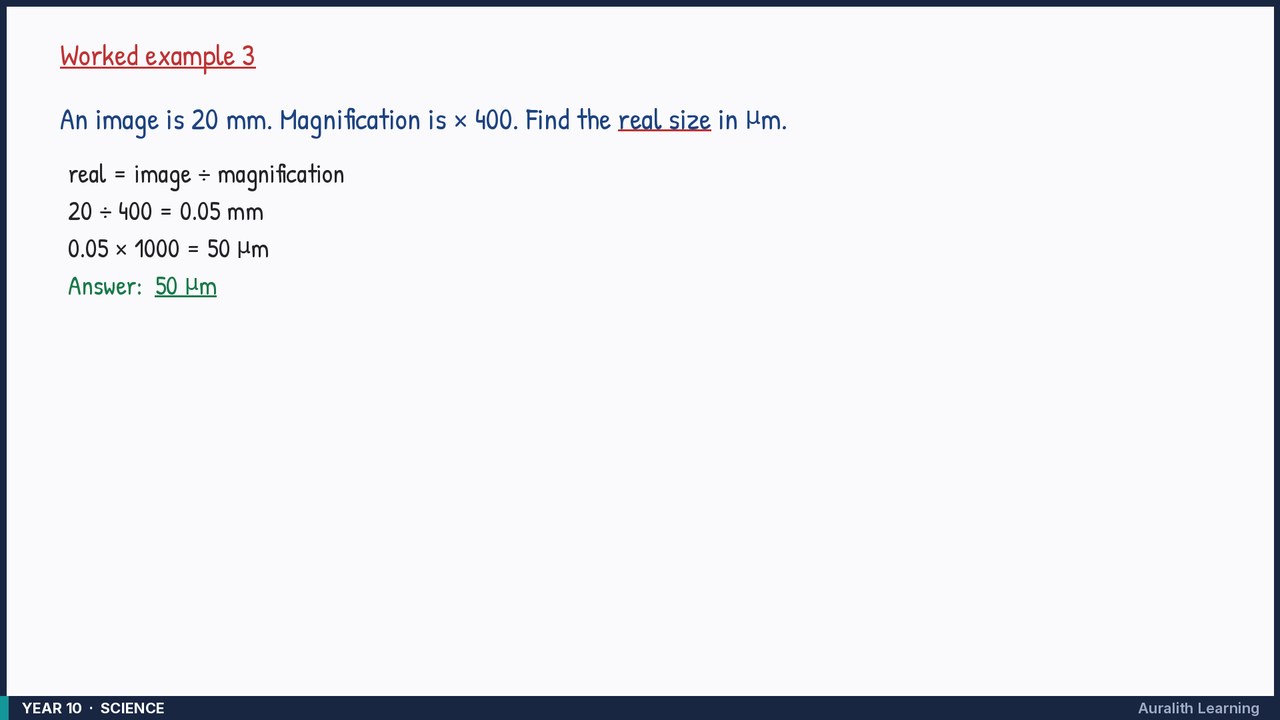
An image is 20 mm. Magnification is × 400. Find the real size in µm.
- Step 1: real = image ÷ magnification
- Step 2: 20 ÷ 400 = 0.05 mm
- Step 3: 0.05 × 1000 = 50 µm
Answer: 50 µm