Year 10 (ages 14–15, Grade 9 in the US) · Science · Biology: key concepts · Lesson 3
Enzymes, diffusion, osmosis and active transport
How enzymes work (lock and key, active site, denaturing), how temperature and pH affect them, and how substances move into and out of cells by diffusion, osmosis and active transport.
Exam boards: this lesson matches the AQA and Pearson Edexcel GCSE science courses. Check which course your school follows.
10-minute video lesson
Teaching, worked examples and 20 practice questions solved step by step.
Watch free for a monthWhat your child will learn
- Explain the lock and key model
- Explain the effect of temperature and pH
- Calculate a rate of reaction
- Compare diffusion, osmosis and active transport
The method
- Enzymes: substrate fits the active site.
- Too hot or wrong pH: active site changes shape (denatured).
- Rate = amount ÷ time, or 1000 ÷ time.
- Transport: is energy used? Which way is the concentration?
Key words: enzyme, active site, denatured, osmosis, active transport.
Worked examples
Worked examples from the lesson, with every step.
Question 1
Explain why an enzyme only works on one substrate.
- Step 1: The active site has a specific shape.
- Step 2: Only one substrate fits, like a key in a lock.
Answer: the substrate must fit the shape of the active site
Question 2
Explain why amylase stops working at 70 °C.
- Step 1: Too hot: the active site changes shape.
- Step 2: Starch no longer fits.
- Step 3: The enzyme is denatured.
Answer: it is denatured, so starch cannot fit the active site
Question 3
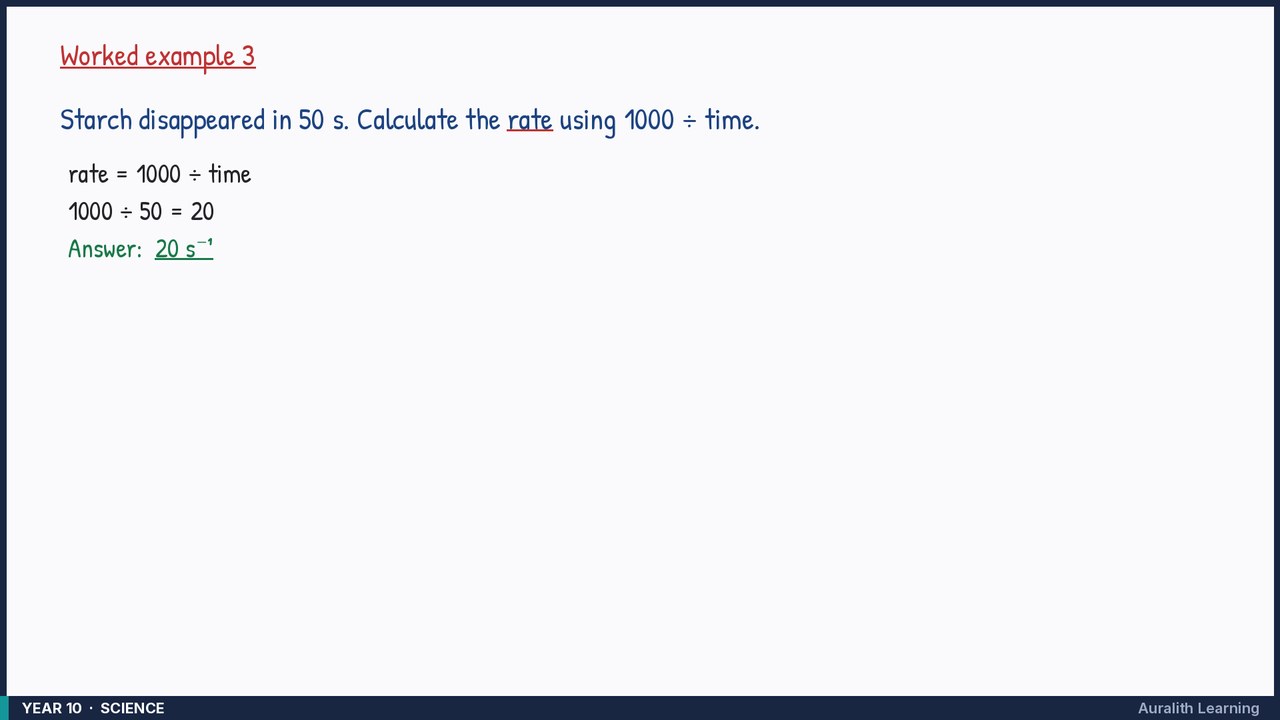
Starch disappeared in 50 s. Calculate the rate using 1000 ÷ time.
- Step 1: rate = 1000 ÷ time
- Step 2: 1000 ÷ 50 = 20
Answer: 20 s⁻¹