Year 10 (ages 14–15, Grade 9 in the US) · Science · Biology: key concepts · Lesson 1
Eukaryotic and prokaryotic cells
The structures in animal, plant and bacterial cells and their functions, the difference between eukaryotic and prokaryotic cells, and how sperm, egg and ciliated cells are specialised.
Exam boards: this lesson matches the AQA and Pearson Edexcel GCSE science courses. Check which course your school follows.
9-minute video lesson
Teaching, worked examples and 20 practice questions solved step by step.
Watch free for a monthWhat your child will learn
- Name cell structures and their functions
- Compare animal, plant and bacterial cells
- Distinguish eukaryotic and prokaryotic cells
- Explain how specialised cells are adapted
The method
- Name the structure.
- State its function.
- Say which cell types have it.
- Link the structure to the job of the cell.
Key words: eukaryotic, prokaryotic, nucleus, plasmid, specialised.
Worked examples
Worked examples from the lesson, with every step.
Question 1
Which structure controls what enters and leaves a cell?
- Step 1: It surrounds the cell.
- Step 2: It is partially permeable.
Answer: the cell membrane
Question 2
Name three structures found in plant cells but not animal cells.
- Step 1: Think photosynthesis and support.
- Step 2: Cell wall, chloroplasts, permanent vacuole.
Answer: cell wall, chloroplasts, permanent vacuole
Question 3
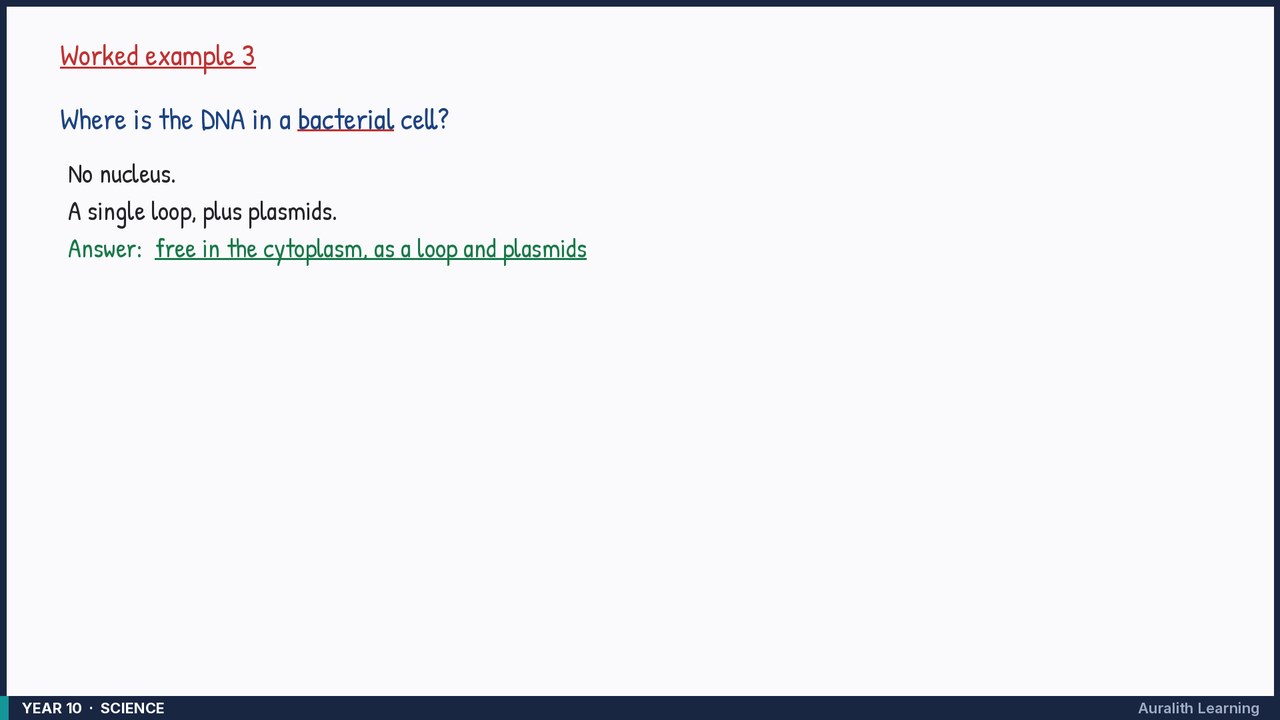
Where is the DNA in a bacterial cell?
- Step 1: No nucleus.
- Step 2: A single loop, plus plasmids.
Answer: free in the cytoplasm, as a loop and plasmids