Year 10 (ages 14–15, Grade 9 in the US) · Science · Biology: genetics · Lesson 3
Inheritance and genetic diagrams
Alleles, dominant and recessive, genotype and phenotype, homozygous and heterozygous, using Punnett squares to predict outcomes as ratios, percentages and probabilities, and how sex is determined.
Exam boards: this lesson matches the AQA and Pearson Edexcel GCSE science courses. Check which course your school follows.
9-minute video lesson
Teaching, worked examples and 20 practice questions solved step by step.
Watch free for a monthWhat your child will learn
- Use key genetics vocabulary
- Draw a Punnett square
- Express outcomes as ratios, % and probability
- Explain sex determination
The method
- Write each parent's alleles: capital = dominant.
- Draw a 2 × 2 Punnett square.
- Fill in each box with one allele from each parent.
- Count the outcomes: ratio, % or probability.
Key words: allele, dominant, recessive, genotype, phenotype.
Worked examples
Worked examples from the lesson, with every step.
Question 1
B = brown eyes (dominant), b = blue. What is the phenotype of Bb?
- Step 1: One dominant allele is enough.
- Step 2: Brown shows.
Answer: brown eyes
Question 2
Cross Bb × bb. What fraction of offspring have blue eyes?
- Step 1: Boxes: Bb, Bb, bb, bb.
- Step 2: bb = 2 of 4.
Answer: 1/2 (50%)
Question 3
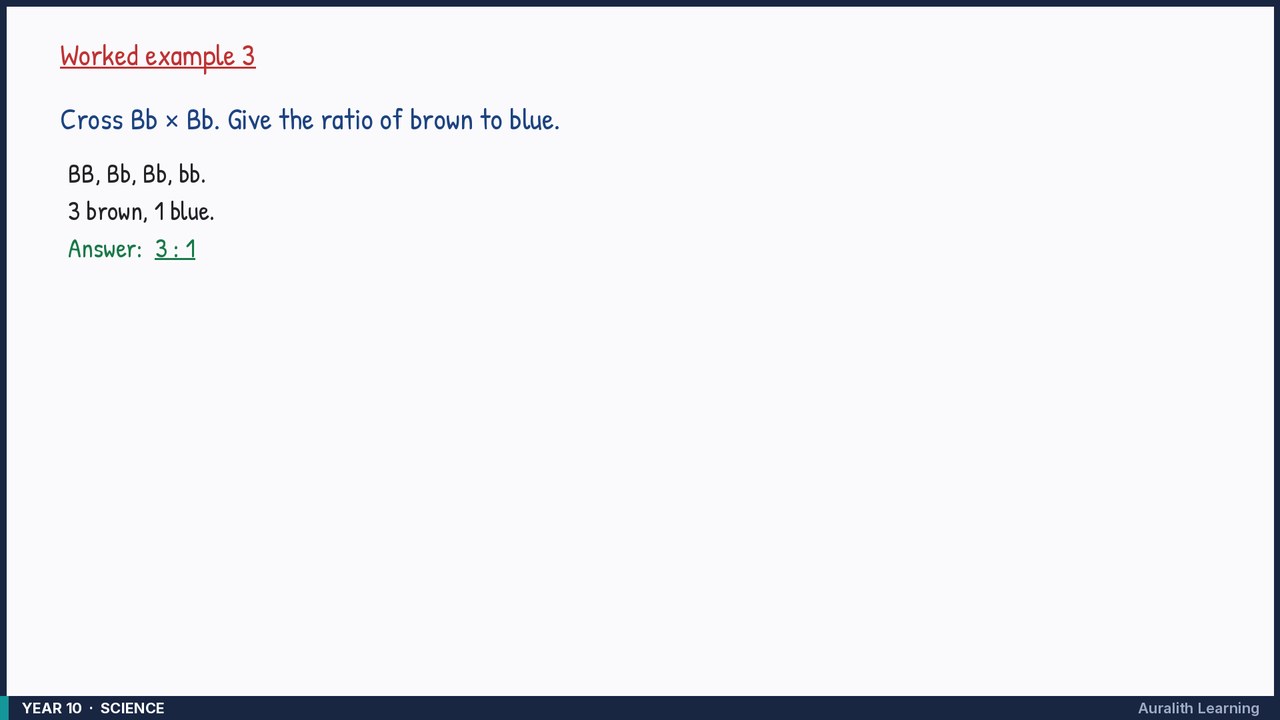
Cross Bb × Bb. Give the ratio of brown to blue.
- Step 1: BB, Bb, Bb, bb.
- Step 2: 3 brown, 1 blue.
Answer: 3 : 1