Year 10 (ages 14–15, Grade 9 in the US) · Science · Biology: genetics · Lesson 2
DNA, genes and the genome
The structure of DNA as a double helix of nucleotides with complementary base pairs, what genes and the genome are, how to extract DNA from fruit, and why the Human Genome Project matters.
Exam boards: this lesson matches the AQA and Pearson Edexcel GCSE science courses. Check which course your school follows.
9-minute video lesson
Teaching, worked examples and 20 practice questions solved step by step.
Watch free for a monthWhat your child will learn
- Describe the structure of DNA
- Use complementary base pairing
- Define gene, chromosome and genome
- Describe how to extract DNA from fruit
The method
- DNA: two strands twisted into a double helix.
- Bases pair: A with T, C with G.
- Gene: a section of DNA that codes for a protein.
- Genome: all the DNA of an organism.
Key words: double helix, nucleotide, base pair, gene, genome.
Worked examples
Worked examples from the lesson, with every step.
Question 1
One DNA strand reads A T T G C. What is the complementary strand?
- Step 1: A↔T, C↔G.
- Step 2: A→T, T→A, T→A, G→C, C→G
Answer: T A A C G
Question 2
A DNA sample has 30% A. What % is T?
- Step 1: A pairs with T, so A = T.
- Step 2: T = 30%.
Answer: 30%
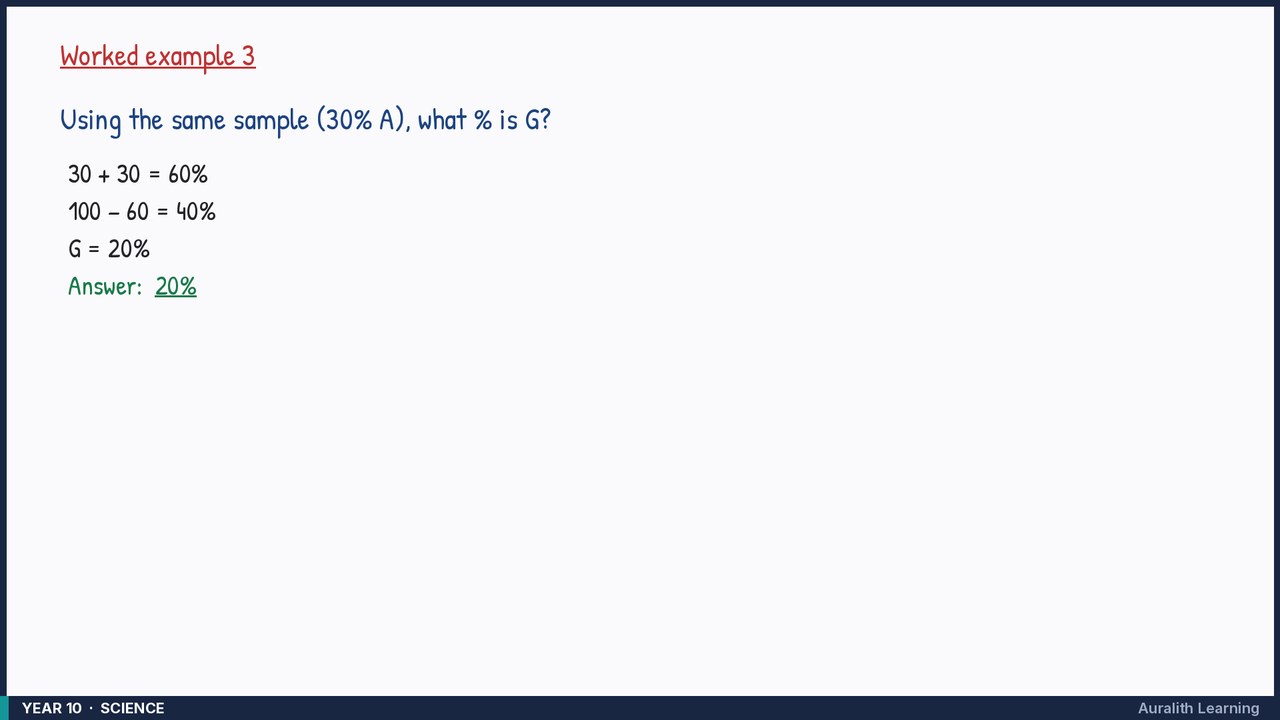
Question 3
Using the same sample (30% A), what % is G?
- Step 1: 30 + 30 = 60%
- Step 2: 100 − 60 = 40%
- Step 3: G = 20%
Answer: 20%