Year 10 (ages 14–15, Grade 9 in the US) · Maths · Equations and inequalities · Lesson 2
Solving quadratics by factorising
Solve quadratic equations by factorising, including those with no constant term, the difference of two squares and rearranging first, and use them in problems.
Exam boards: this lesson matches the AQA and Pearson Edexcel GCSE maths courses. Check which course your school follows.
28-minute video lesson
Teaching, worked examples and 20 practice questions solved step by step.
Watch free for a monthWhat your child will learn
- Rearrange to equal zero
- Factorise and solve
- Handle special cases
- Solve quadratic problems
The method
- Rearrange so it equals 0.
- Factorise.
- Set each bracket equal to 0.
- Solve; check both answers.
Key words: quadratic, factorise, root, solution, zero product.
Worked examples
Worked examples from the lesson, with every step.
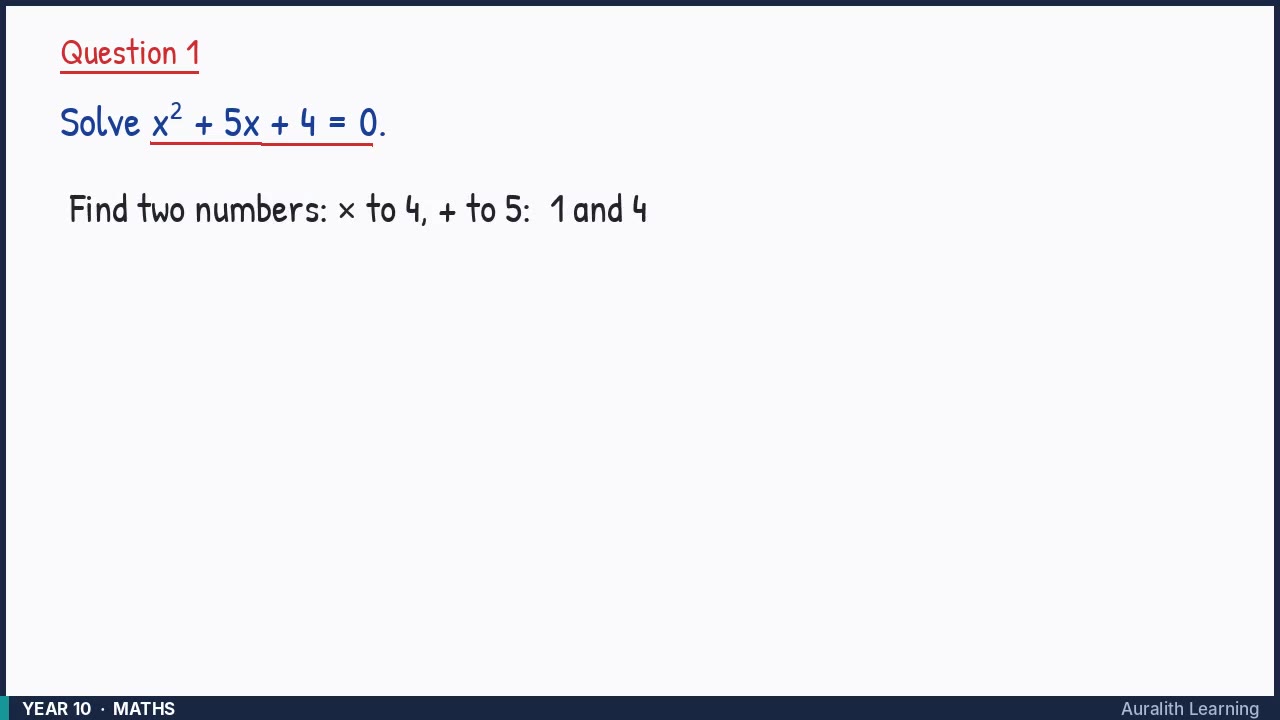
Question 1
Solve x² + 5x + 4 = 0.
- Step 1: Find two numbers: × to 4, + to 5: 1 and 4
- Step 2: Factorise: (x + 1)(x + 4) = 0
- Step 3: Each bracket = 0: x + 1 = 0 or x + 4 = 0
- Step 4: x = −1 or x = −4
- Step 5: Check x = −1: 1 − 5 + 4 = 0
Answer: x = −1 or x = −4
Question 2
Solve x² + 8x + 15 = 0.
- Step 1: Find two numbers: × to 15, + to 8: 3 and 5
- Step 2: Factorise: (x + 3)(x + 5) = 0
- Step 3: Each bracket = 0: x + 3 = 0 or x + 5 = 0
- Step 4: x = −3 or x = −5
- Step 5: Check x = −3: 9 − 24 + 15 = 0
Answer: x = −3 or x = −5
Question 3
Solve x² − 6x + 8 = 0.
- Step 1: Find two numbers: × to 8, + to −6: −4 and −2
- Step 2: Factorise: (x − 4)(x − 2) = 0
- Step 3: Each bracket = 0: x − 4 = 0 or x − 2 = 0
- Step 4: x = 4 or x = 2
- Step 5: Check x = 4: 16 − 24 + 8 = 0
Answer: x = 4 or x = 2