Year 10 (ages 14–15, Grade 9 in the US) · Maths · Equations and inequalities · Lesson 3
The quadratic formula
Use the quadratic formula to solve quadratic equations to a given accuracy, use the discriminant to decide how many solutions there are, and solve contextual problems.
Exam boards: this lesson matches the AQA and Pearson Edexcel GCSE maths courses. Check which course your school follows.
11-minute video lesson
Teaching, worked examples and 20 practice questions solved step by step.
Watch free for a monthWhat your child will learn
- Identify a, b and c
- Use the quadratic formula
- Use the discriminant
- Solve problems with quadratics
The method
- Make it = 0; write a, b and c.
- Work out b² − 4ac first.
- Substitute (brackets for negatives).
- Find both answers; round at the end.
Key words: quadratic formula, discriminant, root, coefficient, plus or minus.
Worked examples
Worked examples from the lesson, with every step.
Question 1
Solve x² + 7x + 3 = 0, giving your answers to 2 decimal places.
- Step 1: 1, 7, 3
- Step 2: 49 − 12 = 37
- Step 3: (−7 ± √37)/2
Answer: x = −0.46 or x = −6.54
Question 2
Solve x² − 3x − 1 = 0, giving your answers to 2 decimal places.
- Step 1: 9 + 4 = 13
- Step 2: (3 ± √13)/2
Answer: x = 3.30 or x = −0.30
Question 3
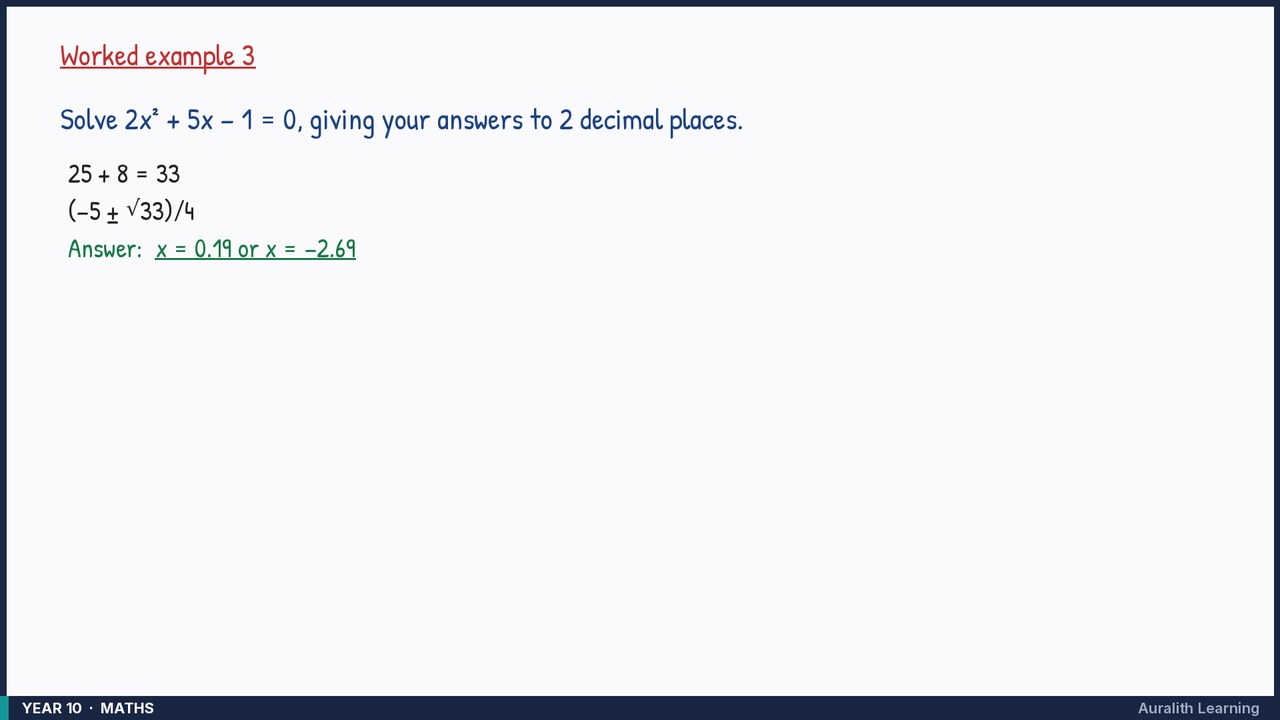
Solve 2x² + 5x − 1 = 0, giving your answers to 2 decimal places.
- Step 1: 25 + 8 = 33
- Step 2: (−5 ± √33)/4
Answer: x = 0.19 or x = −2.69