Year 10 (ages 14–15, Grade 9 in the US) · Maths · Equations and inequalities · Lesson 4
Equation problems
Form and solve linear and quadratic equations (and simple inequalities) from word problems involving numbers, shapes, ages, money and speed, interpreting solutions in context.
Exam boards: this lesson matches the AQA and Pearson Edexcel GCSE maths courses. Check which course your school follows.
9-minute video lesson
Teaching, worked examples and 20 practice questions solved step by step.
Watch free for a monthWhat your child will learn
- Define variables
- Form linear and quadratic equations
- Solve and interpret
- Reject impossible solutions
The method
- Let x = the unknown (with units).
- Form an equation.
- Solve it.
- Answer in context; reject impossible values.
Key words: form, equation, quadratic, consecutive, context.
Worked examples
Worked examples from the lesson, with every step.
Question 1
Four consecutive whole numbers add up to 66. Find the smallest number.
- Step 1: n + n + 1 + n + 2 + n + 3 = 66
- Step 2: 4n + 6 = 66, n = 15
Answer: 15
Question 2
I think of a number, treble it and subtract 7. The answer is 26. Find the number.
- Step 1: 3x − 7 = 26
Answer: 11
Question 3
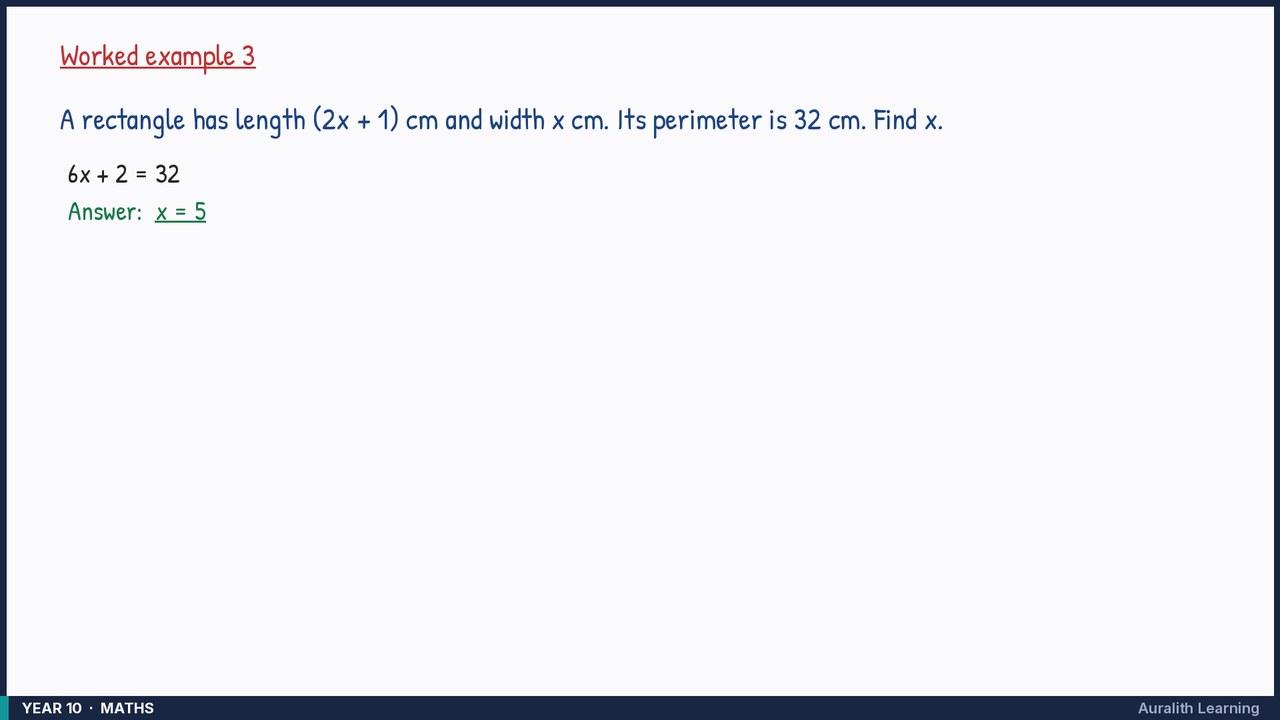
A rectangle has length (2x + 1) cm and width x cm. Its perimeter is 32 cm. Find x.
- Step 1: 6x + 2 = 32
Answer: x = 5