Year 10 (ages 14–15, Grade 9 in the US) · History · Cold War in Asia and the arms race · Lesson 2
The Vietnam War, 1954–72
How the USA was drawn into Vietnam after the French defeat in 1954, the domino theory, the Gulf of Tonkin incident and escalation under Johnson, the tactics of both sides, the turning point of the Tet Offensive in 1968, and Nixon's policy of Vietnamisation.
Exam boards: this lesson matches the AQA GCSE history courses. Check which course your school follows.
9-minute video lesson
Teaching, worked examples and 20 practice questions solved step by step.
Watch free for a monthWhat your child will learn
- Explain why the USA became involved in Vietnam
- Describe how and why the war escalated
- Compare the tactics of the USA and the Viet Cong
- Explain why the USA changed policy after 1968
The method
- Why did the USA get involved?
- What made the war escalate?
- Why couldn't the USA win?
- What changed in 1968?
- What did Nixon do?
Key words: domino theory, escalation, guerrilla warfare, Tet Offensive, Vietnamisation.
Worked examples
Worked examples from the lesson, with every step.
Question 1
Describe two reasons why the USA became involved in Vietnam. (4 marks)
- Step 1: Fear that communism would spread across Asia.
- Step 2: Supporting non-communist South Vietnam against the communist North.
Answer: the domino theory; containment of communism
Question 2
What was the significance of the Gulf of Tonkin incident?
- Step 1: Reported clashes with US ships in August 1964.
- Step 2: Congress gave Johnson power to escalate the war.
Answer: it allowed Johnson to escalate US involvement
Question 3
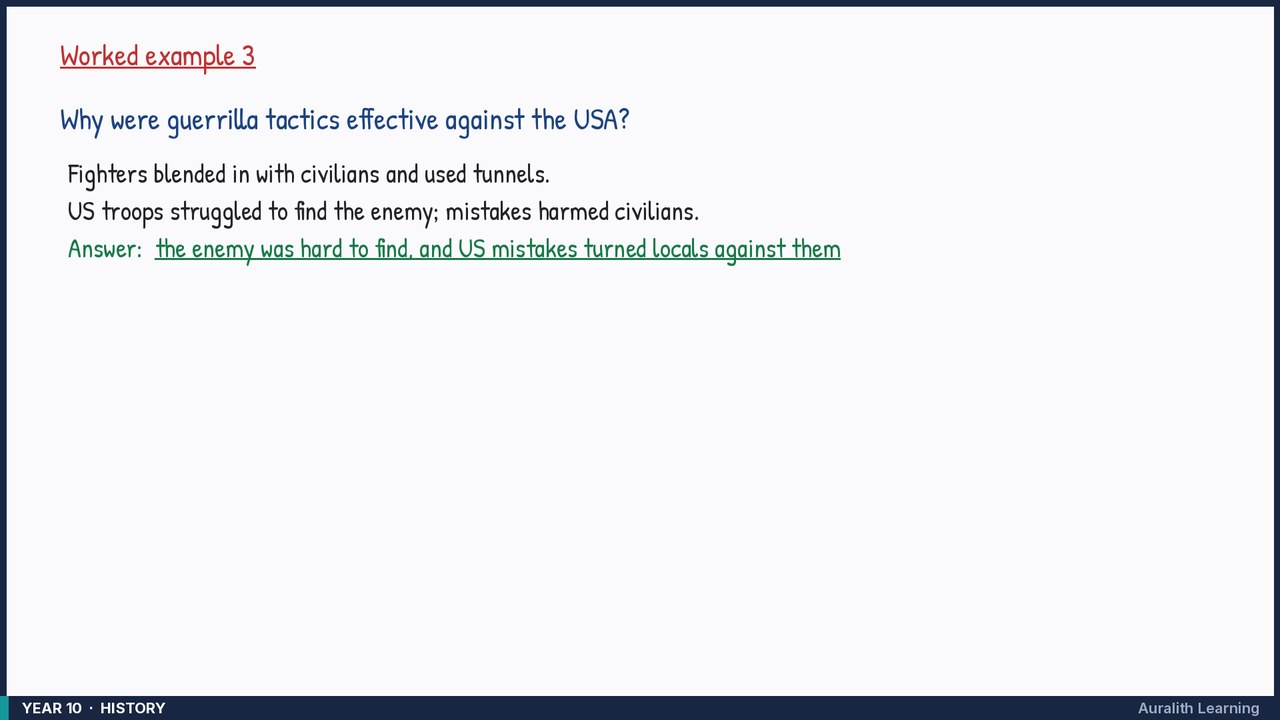
Why were guerrilla tactics effective against the USA?
- Step 1: Fighters blended in with civilians and used tunnels.
- Step 2: US troops struggled to find the enemy; mistakes harmed civilians.
Answer: the enemy was hard to find, and US mistakes turned locals against them