Year 10 (ages 14–15, Grade 9 in the US) · History · Cold War in Asia and the arms race · Lesson 3
The arms race, the space race and the U2 crisis
The military rivalry of the 1950s: NATO and the Warsaw Pact, the nuclear arms race from atomic to hydrogen bombs and missiles, the space race from Sputnik to the Moon, the ‘Thaw’ after Stalin's death, and how the U2 spy-plane crisis of 1960 wrecked the Paris summit.
Exam boards: this lesson matches the AQA GCSE history courses. Check which course your school follows.
9-minute video lesson
Teaching, worked examples and 20 practice questions solved step by step.
Watch free for a monthWhat your child will learn
- Describe NATO and the Warsaw Pact
- Explain how the nuclear arms race developed
- Explain why the space race mattered
- Explain the causes and effects of the U2 crisis
The method
- What alliances divided Europe?
- How did weapons develop?
- Why did space matter?
- What was the Thaw?
- How did the U2 crisis end it?
Key words: arms race, deterrent, ICBM, Thaw, U2.
Worked examples
Worked examples from the lesson, with every step.
Question 1
Describe two features of the nuclear arms race. (4 marks)
- Step 1: Both sides developed hydrogen bombs in the early 1950s.
- Step 2: Both built intercontinental missiles able to reach each other.
Answer: hydrogen bombs; intercontinental missiles
Question 2
Why did Sputnik alarm the USA?
- Step 1: The rocket that launched it could carry a nuclear warhead.
- Step 2: The USSR seemed ahead in science.
Answer: it showed Soviet rockets might reach the USA, and the USSR seemed ahead
Question 3
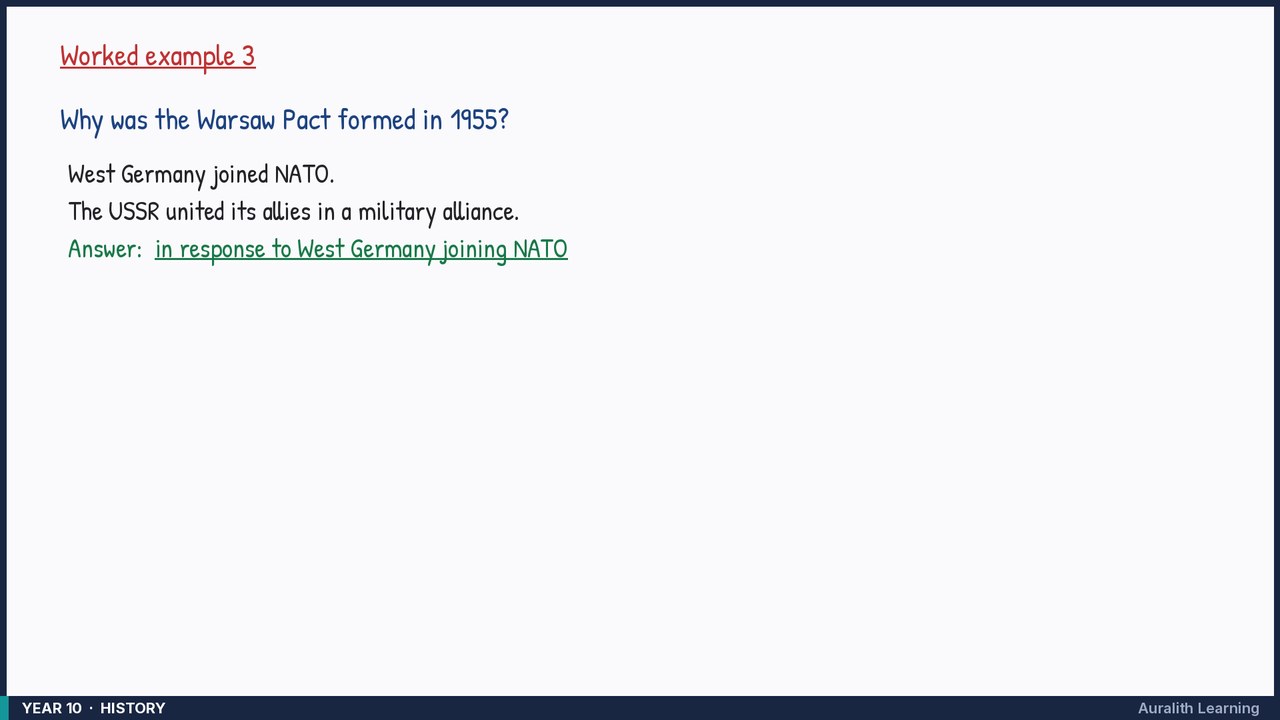
Why was the Warsaw Pact formed in 1955?
- Step 1: West Germany joined NATO.
- Step 2: The USSR united its allies in a military alliance.
Answer: in response to West Germany joining NATO