Year 10 (ages 14–15, Grade 9 in the US) · History · Cold War in Asia and the arms race · Lesson 1
Communist China and the Korean War, 1949–53
How Mao's Communist victory in China in 1949 and Soviet support for it alarmed the USA, and how the Korean War of 1950–53 turned containment into fighting: the North's invasion, the UN response, MacArthur's advance, China's intervention and the 1953 armistice.
Exam boards: this lesson matches the AQA GCSE history courses. Check which course your school follows.
9-minute video lesson
Teaching, worked examples and 20 practice questions solved step by step.
Watch free for a monthWhat your child will learn
- Explain why the Communist victory in China worried the USA
- Describe the causes and main events of the Korean War
- Explain why the UN and China became involved
- Assess the war's significance for superpower relations
The method
- Why did events in Asia matter to the superpowers?
- What started the Korean War?
- How did the war change direction?
- How did it end?
- What were its consequences?
Key words: containment, 38th parallel, United Nations, armistice, stalemate.
Worked examples
Worked examples from the lesson, with every step.
Question 1
Describe two reasons why 1949 alarmed the USA. (4 marks)
- Step 1: Mao's Communists won China, the world's most populous country.
- Step 2: The USSR tested an atomic bomb, ending the US monopoly.
Answer: the Communist victory in China; the first Soviet atomic bomb
Question 2
Why was the UN able to send troops to Korea?
- Step 1: Any permanent Security Council member could veto action.
- Step 2: The USSR was boycotting the Council, so did not veto.
Answer: the USSR was boycotting the Security Council and could not veto
Question 3
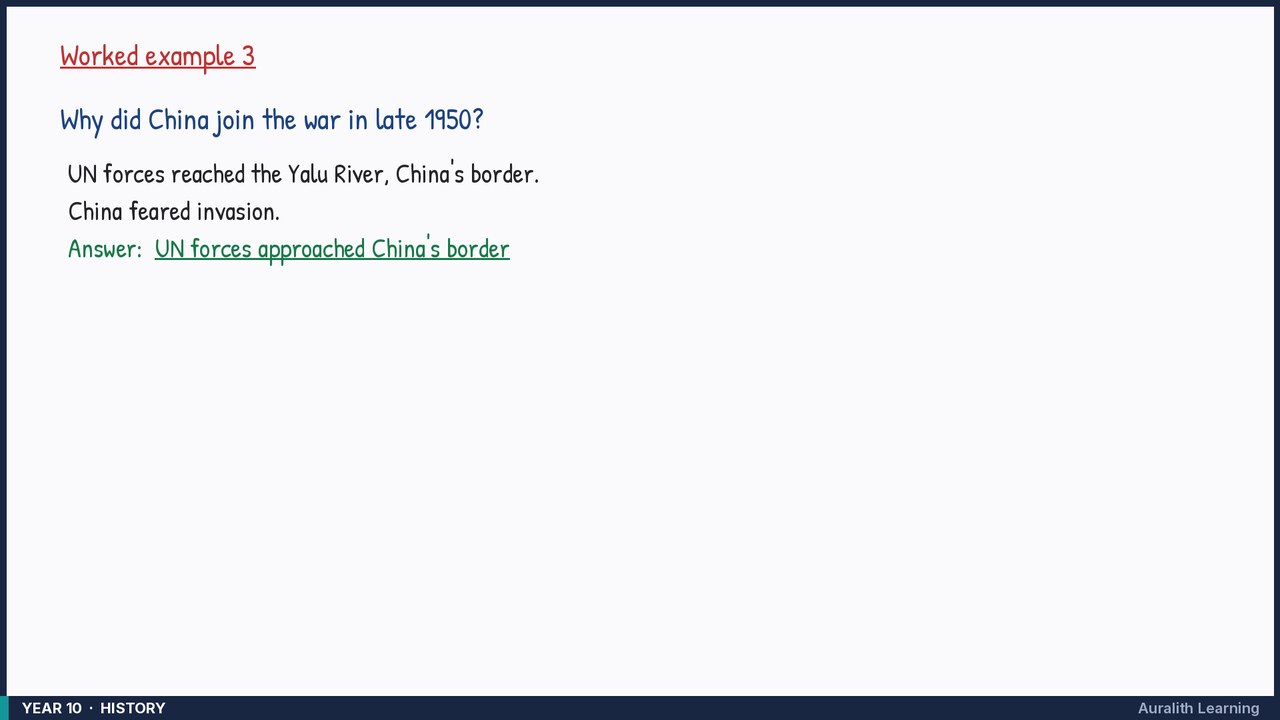
Why did China join the war in late 1950?
- Step 1: UN forces reached the Yalu River, China's border.
- Step 2: China feared invasion.
Answer: UN forces approached China's border