Year 10 (ages 14–15, Grade 9 in the US) · History · Health and the people: further topics · Lesson 2
Quackery, new hospitals and John Hunter, c1700–c1800
Medicine in 18th-century Britain: quacks selling fake cures, the founding of new voluntary hospitals funded by the wealthy, the separation of surgeons from barbers in 1745, and how John Hunter's scientific approach to surgery and teaching influenced doctors such as Edward Jenner.
Exam boards: this lesson matches the AQA GCSE history courses. Check which course your school follows.
9-minute video lesson
Teaching, worked examples and 20 practice questions solved step by step.
Watch free for a monthWhat your child will learn
- Explain why quackery was common
- Describe the growth of hospitals in the 1700s
- Explain how the training of surgeons changed
- Assess John Hunter's significance
The method
- Who treated the sick in the 1700s?
- Why did quacks thrive?
- What new hospitals opened, and how were they funded?
- How did surgical training change?
- What did John Hunter contribute?
Key words: quack, voluntary hospital, dissection, experiment, observation.
Worked examples
Worked examples from the lesson, with every step.
Question 1
Describe two reasons why quackery was common in the 1700s. (4 marks)
- Step 1: Trained doctors were expensive, so the poor used quacks.
- Step 2: No laws tested medicines; printing helped quacks advertise.
Answer: doctors were expensive; there was no regulation, and advertising spread
Question 2
How were 18th-century voluntary hospitals funded?
- Step 1: Donations from wealthy people.
Answer: by donations from wealthy people
Question 3
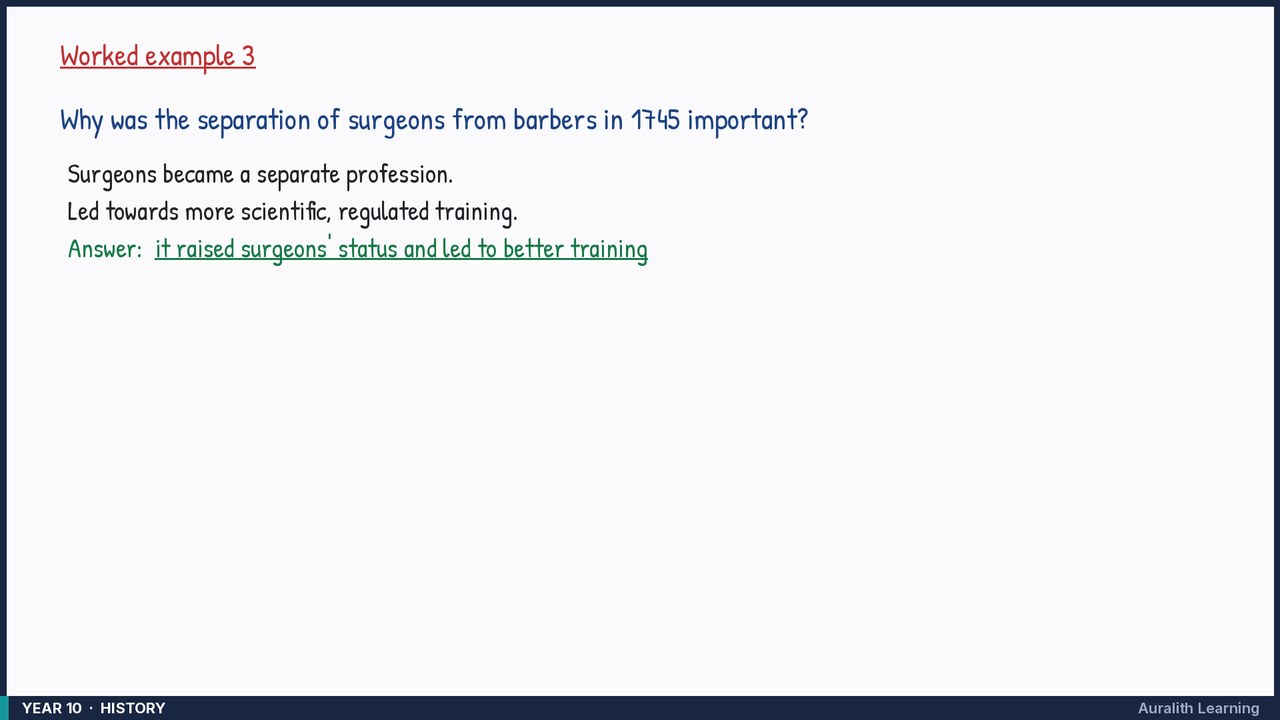
Why was the separation of surgeons from barbers in 1745 important?
- Step 1: Surgeons became a separate profession.
- Step 2: Led towards more scientific, regulated training.
Answer: it raised surgeons' status and led to better training