Year 10 (ages 14–15, Grade 9 in the US) · History · Health and the people: further topics · Lesson 4
Public health from Booth and Rowntree to the NHS
How investigations into poverty by Charles Booth and Seebohm Rowntree, and the poor health of Boer War recruits, led to the Liberal reforms of 1906–1914; how the Beveridge Report of 1942 led to the NHS in 1948; and the costs and choices in public health since.
Exam boards: this lesson matches the AQA GCSE history courses. Check which course your school follows.
9-minute video lesson
Teaching, worked examples and 20 practice questions solved step by step.
Watch free for a monthWhat your child will learn
- Explain how Booth, Rowntree and the Boer War changed attitudes
- Describe the Liberal reforms
- Explain why the NHS was created in 1948
- Describe challenges facing public health since 1948
The method
- What did investigators discover about poverty?
- How did government respond, 1906–14?
- What did Beveridge recommend?
- What did the NHS provide?
- What challenges came later?
Key words: poverty line, Liberal reforms, welfare state, Beveridge Report, NHS.
Worked examples
Worked examples from the lesson, with every step.
Question 1
Describe two findings that changed attitudes to poverty around 1900. (4 marks)
- Step 1: About a third of people in London and York lived in poverty.
- Step 2: Many recruits were too unhealthy to fight.
Answer: widespread poverty found by Booth and Rowntree; unfit Boer War recruits
Question 2
Why did the Boer War worry the government?
- Step 1: Many volunteers were rejected as unfit.
- Step 2: Britain might not be able to defend its empire.
Answer: poor health threatened Britain's ability to fight
Question 3
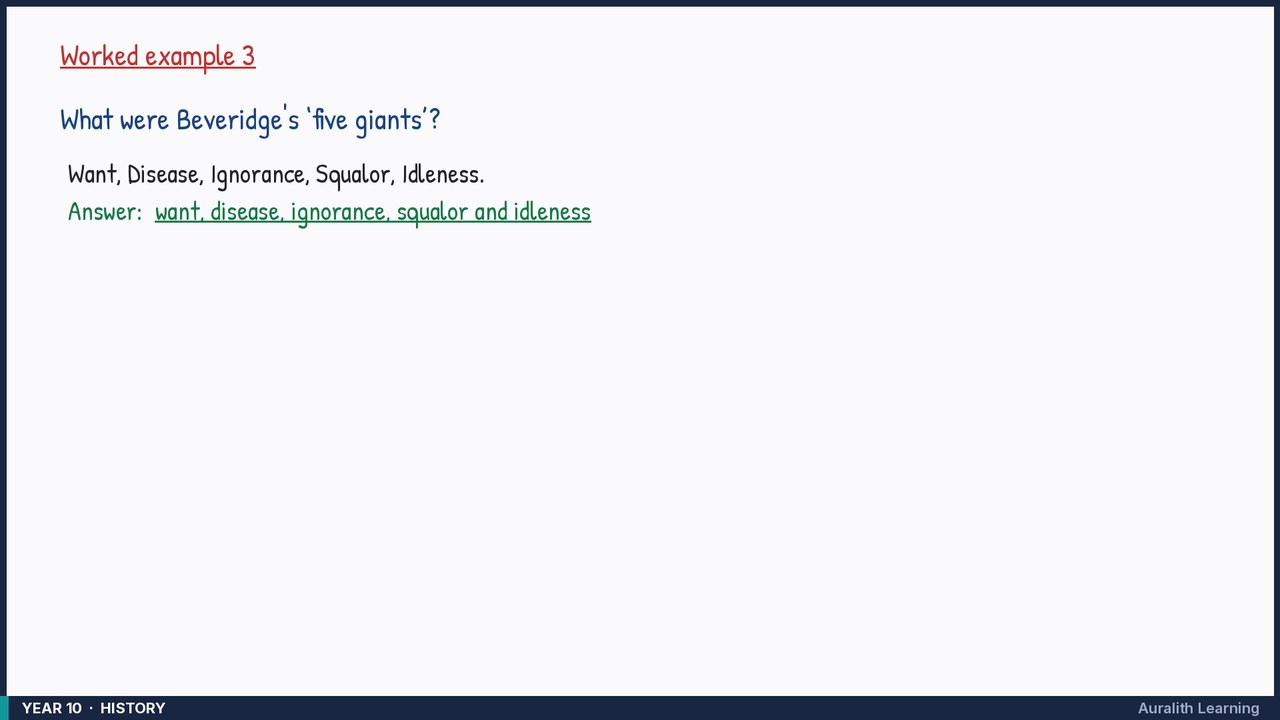
What were Beveridge's ‘five giants’?
- Step 1: Want, Disease, Ignorance, Squalor, Idleness.
Answer: want, disease, ignorance, squalor and idleness