Year 11 (ages 15–16, Grade 10 in the US) · Science · Biology: exchange and transport in animals · Lesson 1
The heart, blood and blood vessels
The double circulatory system, the structure of the heart and how it pumps blood, arteries, veins and capillaries, the components of blood, and treatments for coronary heart disease.
Exam boards: this lesson matches the AQA and Pearson Edexcel GCSE science courses. Check which course your school follows.
8-minute video lesson
Teaching, worked examples and 20 practice questions solved step by step.
Watch free for a monthWhat your child will learn
- Describe the double circulatory system
- Explain how the heart pumps blood
- Compare arteries, veins and capillaries
- Describe the parts of the blood
The method
- Right side → lungs (deoxygenated); left side → body (oxygenated).
- Atria receive blood; ventricles pump it out.
- Valves stop backflow.
- Arteries: thick, high pressure. Veins: valves, low pressure. Capillaries: one cell thick.
Key words: double circulation, atrium, ventricle, artery, capillary.
Worked examples
Worked examples from the lesson, with every step.
Question 1
Why is the human circulatory system called ‘double’?
- Step 1: One loop to the lungs; one to the body.
- Step 2: Blood passes through the heart twice per circuit.
Answer: blood goes through the heart twice per circuit
Question 2
Trace the path of blood from the body to the lungs.
- Step 1: vena cava → right atrium → right ventricle
- Step 2: pulmonary artery → lungs
Answer: vena cava, right atrium, right ventricle, pulmonary artery
Question 3
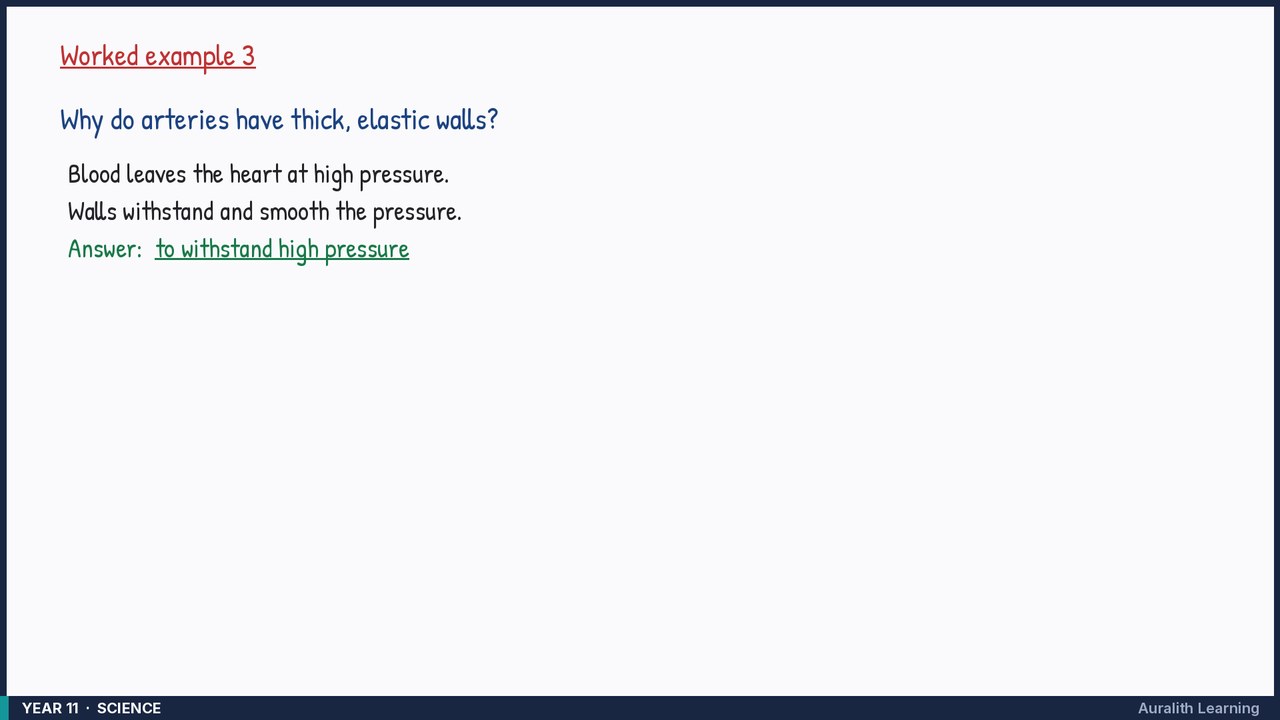
Why do arteries have thick, elastic walls?
- Step 1: Blood leaves the heart at high pressure.
- Step 2: Walls withstand and smooth the pressure.
Answer: to withstand high pressure