Year 11 (ages 15–16, Grade 10 in the US) · Science · Biology: exchange and transport in animals · Lesson 3
Gas exchange and surface area to volume ratio
The structure of the lungs, how alveoli are adapted for gas exchange, why large organisms need exchange surfaces and transport systems, and calculating surface area to volume ratios.
Exam boards: this lesson matches the AQA and Pearson Edexcel GCSE science courses. Check which course your school follows.
9-minute video lesson
Teaching, worked examples and 20 practice questions solved step by step.
Watch free for a monthWhat your child will learn
- Describe the structure of the lungs
- Explain how alveoli are adapted for gas exchange
- Calculate surface area to volume ratio
- Explain why large organisms need exchange surfaces
The method
- Air: trachea → bronchi → bronchioles → alveoli.
- O₂ diffuses into the blood; CO₂ diffuses out.
- Alveoli: huge surface area, thin walls, good blood supply.
- Larger organisms have a smaller SA : V ratio.
Key words: alveoli, diffusion, surface area, volume, concentration gradient.
Worked examples
Worked examples from the lesson, with every step.
Question 1
Describe the pathway of air into the lungs.
- Step 1: trachea → bronchi → bronchioles → alveoli
Answer: trachea, bronchi, bronchioles, alveoli
Question 2
Give three ways alveoli are adapted for gas exchange.
- Step 1: Large surface area.
- Step 2: Thin walls.
- Step 3: Good blood supply.
Answer: large surface area, thin walls, good blood supply
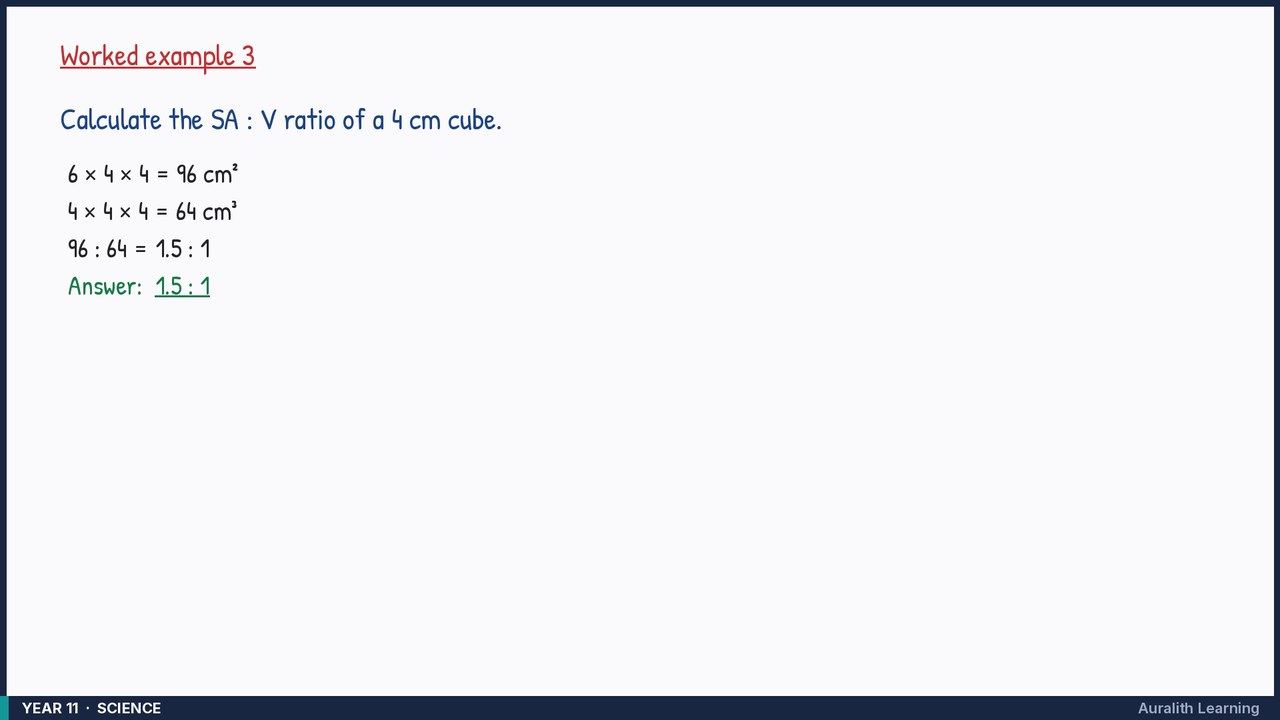
Question 3
Calculate the SA : V ratio of a 4 cm cube.
- Step 1: 6 × 4 × 4 = 96 cm²
- Step 2: 4 × 4 × 4 = 64 cm³
- Step 3: 96 : 64 = 1.5 : 1
Answer: 1.5 : 1