Year 11 (ages 15–16, Grade 10 in the US) · Science · Biology: ecosystems · Lesson 1
Sampling organisms: quadrats, transects and capture–recapture
How ecologists estimate population size and study distribution: random sampling with quadrats, estimating a population from a mean, belt and line transects, the capture–recapture method, and biotic and abiotic factors.
Exam boards: this lesson matches the AQA and Pearson Edexcel GCSE science courses. Check which course your school follows.
9-minute video lesson
Teaching, worked examples and 20 practice questions solved step by step.
Watch free for a monthWhat your child will learn
- Use quadrats to estimate population size
- Use a transect to study distribution
- Calculate a population using capture–recapture
- Identify biotic and abiotic factors
The method
- Place quadrats randomly using coordinates.
- Find the mean number per quadrat.
- Population ≈ mean per m² × total area.
- Capture–recapture: N = (first sample × second sample) ÷ number marked in second.
Key words: quadrat, transect, random sampling, abiotic, biotic.
Worked examples
Worked examples from the lesson, with every step.
Question 1
Why should quadrats be placed randomly?
- Step 1: Choosing places yourself could pick unusual areas.
- Step 2: Random placement gives a fair, representative sample.
Answer: to avoid bias
Question 2
8 quadrats of 1 m² contain 2, 5, 3, 0, 4, 6, 3, 1 buttercups. Find the mean.
- Step 1: 2 + 5 + 3 + 0 + 4 + 6 + 3 + 1 = 24
- Step 2: 24 ÷ 8
Answer: 3 per m²
Question 3
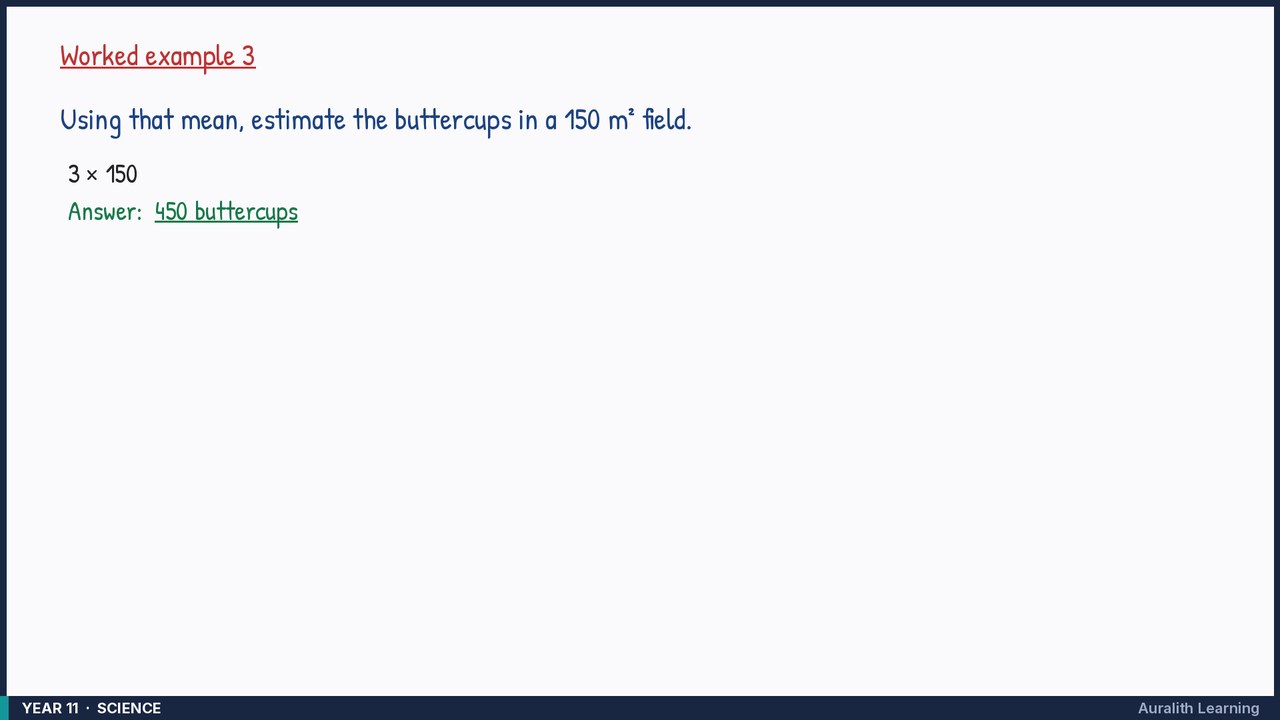
Using that mean, estimate the buttercups in a 150 m² field.
- Step 1: 3 × 150
Answer: 450 buttercups