Year 11 (ages 15–16, Grade 10 in the US) · Science · Required practicals · Lesson 4
Required practicals: reaction time and field investigations
Two more AQA biology required practicals: measuring the effect of a factor on human reaction time with the ruler-drop test, and using quadrats and transects to estimate population size and study how organisms are distributed.
Exam boards: this lesson matches the AQA GCSE science courses. Check which course your school follows.
10-minute video lesson
Teaching, worked examples and 20 practice questions solved step by step.
Watch free for a monthWhat your child will learn
- Plan a fair test of a factor affecting reaction time
- Convert a ruler-drop distance into a reaction time
- Estimate a population using random quadrat sampling
- Use a transect to link distribution to an abiotic factor
The method
- Identify the independent, dependent and control variables.
- Repeat readings and calculate a mean.
- Population = mean per quadrat × (total area ÷ quadrat area).
- Use a transect to see changes along a line.
- Evaluate: how could the method be improved?
Key words: reaction time, quadrat, transect, random sampling, abiotic factor.
Worked examples
Worked examples from the lesson, with every step.
Question 1
In a ruler-drop test the ruler falls 0.20 m. Using t = √(2d ÷ 9.8), find the reaction time to 2 decimal places.
- Step 1: t = √(2 × 0.20 ÷ 9.8) = √(0.0408…)
- Step 2: t = 0.202… seconds
Answer: 0.20 s
Question 2
A student tests whether drinking cola affects reaction time. Name the independent and dependent variables.
- Step 1: Whether cola is drunk.
- Step 2: The distance the ruler falls.
Answer: independent: cola or no cola; dependent: distance fallen
Question 3
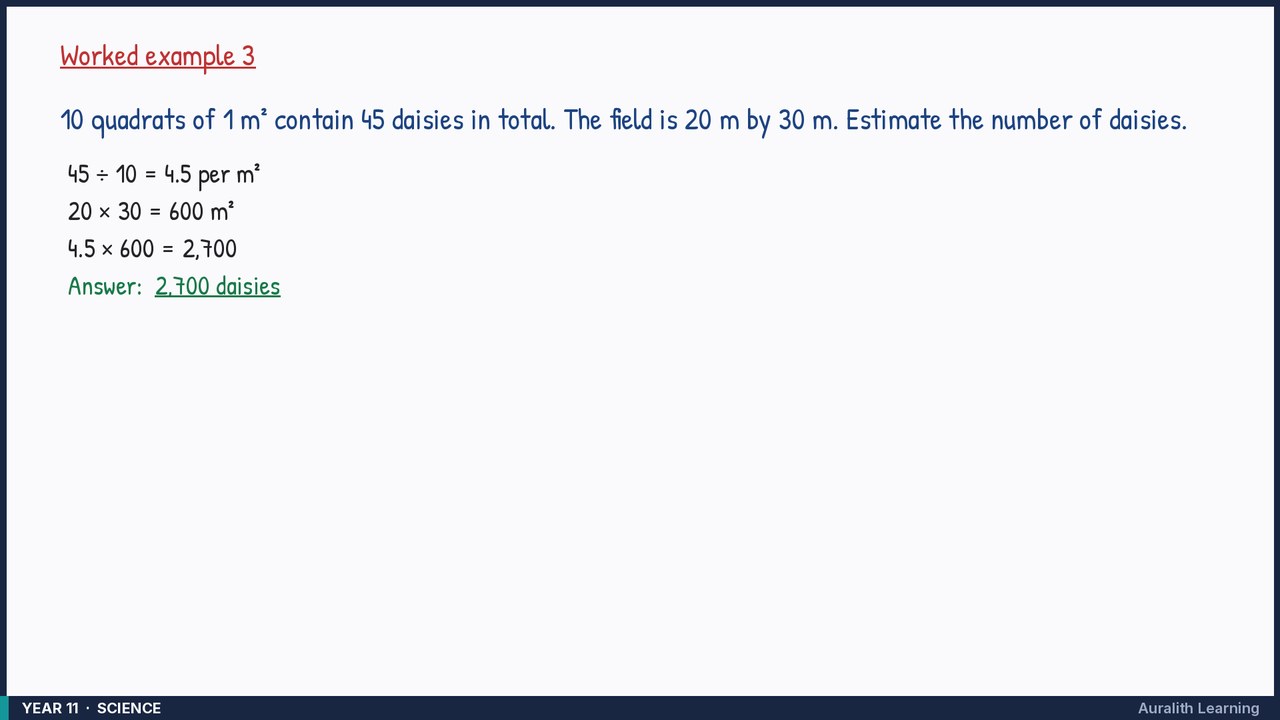
10 quadrats of 1 m² contain 45 daisies in total. The field is 20 m by 30 m. Estimate the number of daisies.
- Step 1: 45 ÷ 10 = 4.5 per m²
- Step 2: 20 × 30 = 600 m²
- Step 3: 4.5 × 600 = 2,700
Answer: 2,700 daisies