Year 11 (ages 15–16, Grade 10 in the US) · Science · Required practicals · Lesson 3
Required practicals: physics
Key physics required practicals — specific heat capacity, resistance of a wire, I–V characteristics, density, force and extension, acceleration, and waves — with methods, variables, graphs and sources of error.
Exam boards: this lesson matches the AQA GCSE science courses. Check which course your school follows.
8-minute video lesson
Teaching, worked examples and 20 practice questions solved step by step.
Watch free for a monthWhat your child will learn
- Describe key physics practical methods
- Identify variables and errors
- Use results to calculate a quantity
- Interpret graphs from practicals
The method
- Write what you change, measure and control.
- Take repeat readings and calculate means.
- Plot a graph and draw a line of best fit.
- Use the gradient or equation to find the answer.
Key words: random error, systematic error, resolution, gradient, light gate.
Worked examples
Worked examples from the lesson, with every step.
Question 1
What is a random error? Give an example.
- Step 1: Unpredictable variation in readings.
- Step 2: Reaction time when using a stopwatch.
Answer: unpredictable scatter, e.g. reaction time
Question 2
What is a systematic error? Give an example.
- Step 1: Readings all wrong by the same amount.
- Step 2: A balance that isn't zeroed.
Answer: a consistent shift, e.g. an unzeroed balance
Question 3
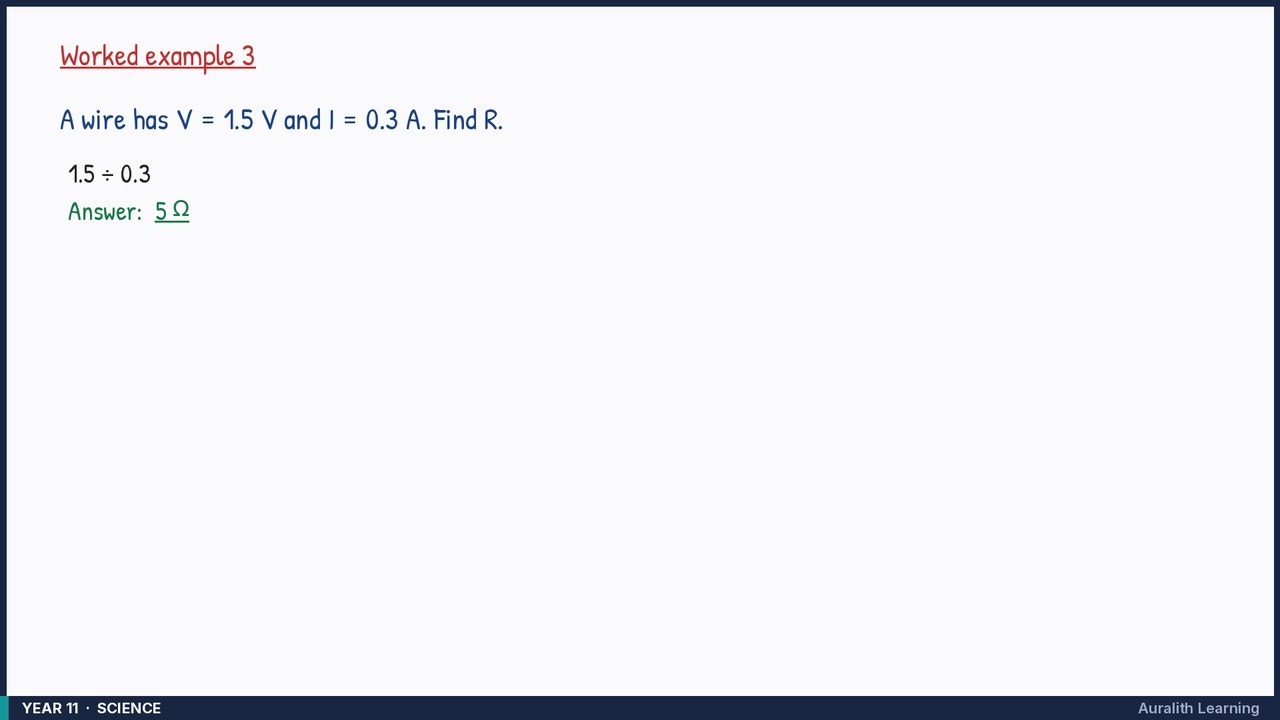
A wire has V = 1.5 V and I = 0.3 A. Find R.
- Step 1: 1.5 ÷ 0.3
Answer: 5 Ω