Year 11 (ages 15–16, Grade 10 in the US) · Science · Chemistry: groups, rates and energy · Lesson 2
Rates of reaction
Measuring and calculating rates of reaction, collision theory and activation energy, and how temperature, concentration, pressure, surface area and catalysts affect the rate.
Exam boards: this lesson matches the AQA and Pearson Edexcel GCSE science courses. Check which course your school follows.
9-minute video lesson
Teaching, worked examples and 20 practice questions solved step by step.
Watch free for a monthWhat your child will learn
- Calculate the mean rate of a reaction
- Explain collision theory
- Explain how four factors affect rate
- Explain how catalysts work
The method
- Mean rate = quantity of product formed ÷ time.
- Reactions happen when particles collide with enough energy.
- More frequent, more energetic collisions → faster rate.
- Catalysts lower the activation energy and aren't used up.
Key words: rate of reaction, collision theory, activation energy, catalyst, surface area.
Worked examples
Worked examples from the lesson, with every step.
Question 1
A reaction gives off 90 cm³ of gas in 45 s. Calculate the mean rate.
- Step 1: rate = volume ÷ time
- Step 2: 90 ÷ 45
Answer: 2 cm³/s
Question 2
Mass decreases by 2.4 g in 60 s. Calculate the mean rate.
- Step 1: rate = mass lost ÷ time
- Step 2: 2.4 ÷ 60
Answer: 0.04 g/s
Question 3
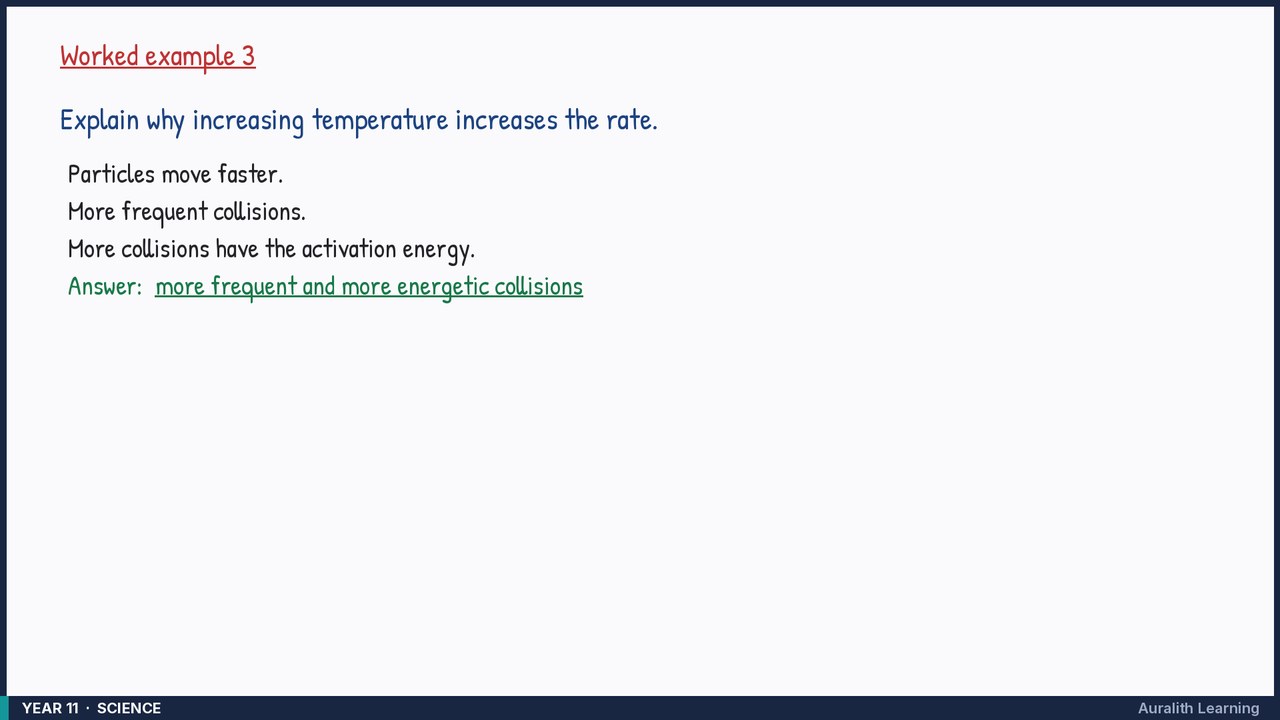
Explain why increasing temperature increases the rate.
- Step 1: Particles move faster.
- Step 2: More frequent collisions.
- Step 3: More collisions have the activation energy.
Answer: more frequent and more energetic collisions