Year 11 (ages 15–16, Grade 10 in the US) · Science · Chemistry: groups, rates and energy · Lesson 1
Groups 1, 7 and 0 of the periodic table
The properties and trends of the alkali metals, the halogens and the noble gases: reactions of Group 1 metals with water, halogen displacement reactions, and why reactivity changes down each group.
Exam boards: this lesson matches the AQA and Pearson Edexcel GCSE science courses. Check which course your school follows.
8-minute video lesson
Teaching, worked examples and 20 practice questions solved step by step.
Watch free for a monthWhat your child will learn
- Describe reactions of Group 1 metals with water
- Explain the reactivity trend in Group 1
- Describe halogen properties and displacement reactions
- Explain why noble gases are unreactive
The method
- Group 1: 1 outer electron; reactivity increases down the group.
- Group 7: 7 outer electrons; reactivity decreases down the group.
- A more reactive halogen displaces a less reactive one.
- Group 0: full outer shells — very unreactive.
Key words: alkali metal, halogen, noble gas, displacement, reactivity.
Worked examples
Worked examples from the lesson, with every step.
Question 1
Write the word equation for potassium reacting with water.
- Step 1: metal + water → metal hydroxide + hydrogen
Answer: potassium + water → potassium hydroxide + hydrogen
Question 2
Explain why potassium is more reactive than sodium.
- Step 1: Outer electron further from the nucleus.
- Step 2: More inner shells shield it.
- Step 3: Weaker attraction, so lost more easily.
Answer: its outer electron is lost more easily
Question 3
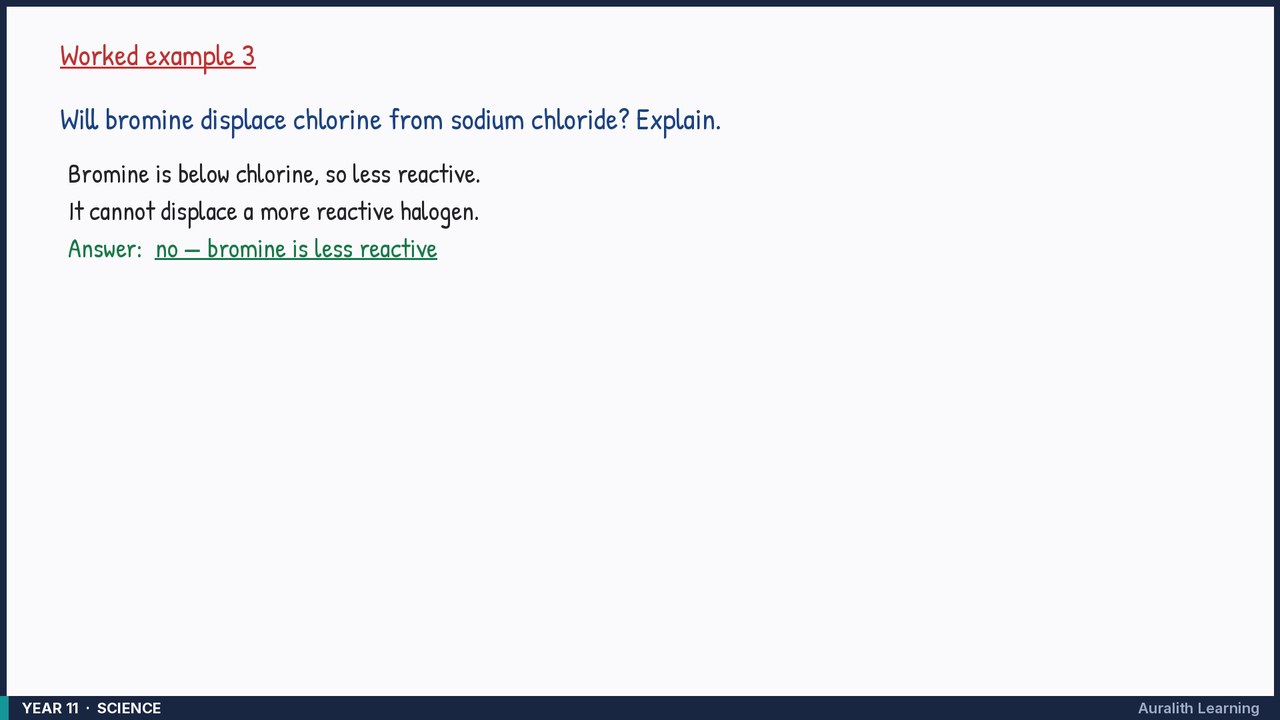
Will bromine displace chlorine from sodium chloride? Explain.
- Step 1: Bromine is below chlorine, so less reactive.
- Step 2: It cannot displace a more reactive halogen.
Answer: no — bromine is less reactive