Year 11 (ages 15–16, Grade 10 in the US) · Science · Physics: magnetism and electromagnetism · Lesson 1
Magnetic fields, electromagnets and the motor effect
Magnetic poles and fields, permanent and induced magnets, the magnetic field around a wire and a solenoid, electromagnets, the motor effect, Fleming's left-hand rule, and the equation F = BIl.
Exam boards: this lesson matches the AQA and Pearson Edexcel GCSE science courses. Check which course your school follows.
8-minute video lesson
Teaching, worked examples and 20 practice questions solved step by step.
Watch free for a monthWhat your child will learn
- Describe magnetic fields and poles
- Describe fields around wires and solenoids
- Explain the motor effect
- Use F = BIl
The method
- Field lines go from north to south.
- A current in a wire makes a circular magnetic field.
- A current-carrying wire in a magnetic field feels a force.
- F = BIl; direction from Fleming's left-hand rule.
Key words: magnetic field, solenoid, electromagnet, motor effect, magnetic flux density.
Worked examples
Worked examples from the lesson, with every step.
Question 1
Two north poles are brought together. What happens?
- Step 1: Like poles repel.
Answer: they repel
Question 2
Give three ways to make an electromagnet stronger.
- Step 1: Increase the current.
- Step 2: Add more turns.
- Step 3: Use an iron core.
Answer: more current, more turns, iron core
Question 3
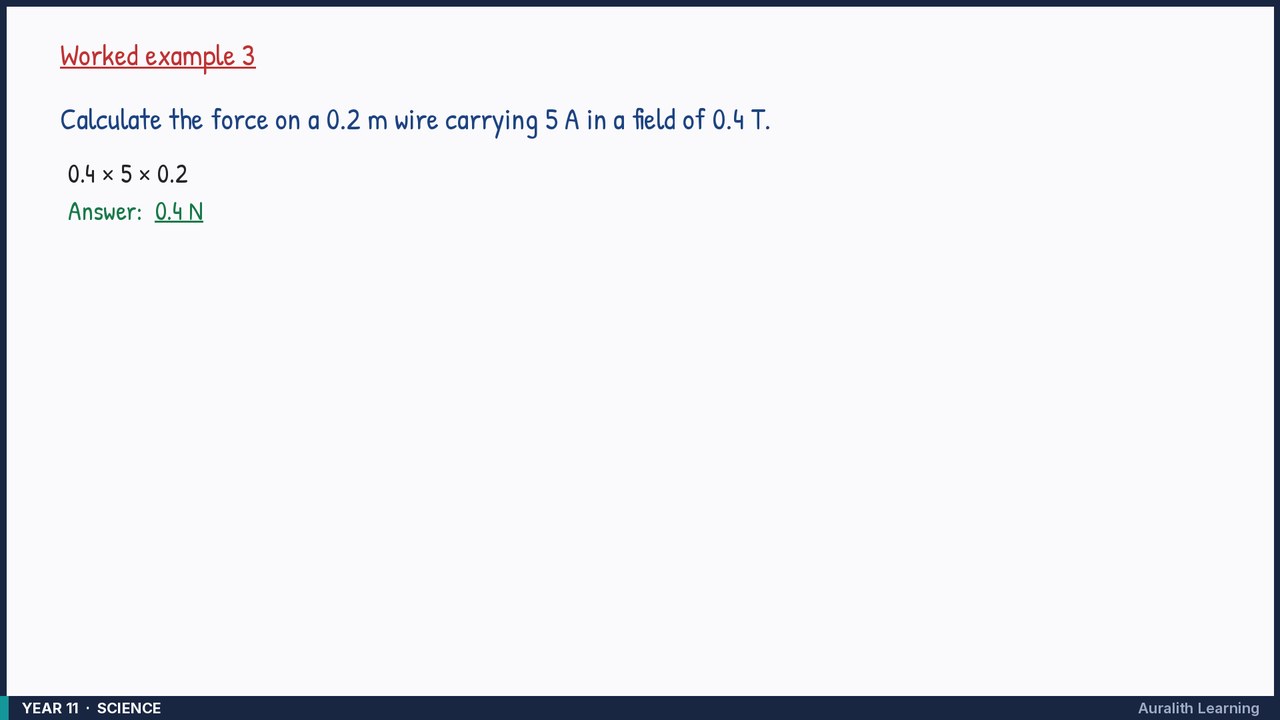
Calculate the force on a 0.2 m wire carrying 5 A in a field of 0.4 T.
- Step 1: 0.4 × 5 × 0.2
Answer: 0.4 N