Year 11 (ages 15–16, Grade 10 in the US) · Science · Physics: magnetism and electromagnetism · Lesson 2
Electromagnetic induction, generators and transformers
How moving a conductor in a magnetic field induces a potential difference, factors affecting the size of the induced p.d., alternators and dynamos, and how transformers change p.d. using the turns ratio.
Exam boards: this lesson matches the AQA and Pearson Edexcel GCSE science courses. Check which course your school follows.
9-minute video lesson
Teaching, worked examples and 20 practice questions solved step by step.
Watch free for a monthWhat your child will learn
- Explain electromagnetic induction
- Describe how generators work
- Explain how transformers work
- Use the transformer equations
The method
- Moving a wire or magnet relative to the other induces a p.d.
- Bigger p.d.: faster movement, stronger magnet, more turns.
- Transformers: a.c. in the primary coil induces a.c. in the secondary.
- Vp ÷ Vs = Np ÷ Ns.
Key words: induction, generator, alternator, transformer, turns ratio.
Worked examples
Worked examples from the lesson, with every step.
Question 1
Give three ways to increase the induced p.d. when moving a magnet in a coil.
- Step 1: Move it faster.
- Step 2: Use a stronger magnet.
- Step 3: Use more turns on the coil.
Answer: faster, stronger magnet, more turns
Question 2
What is the difference between an alternator and a dynamo?
- Step 1: Slip rings; a.c.
- Step 2: Split-ring commutator; d.c.
Answer: alternator gives a.c.; dynamo gives d.c.
Question 3
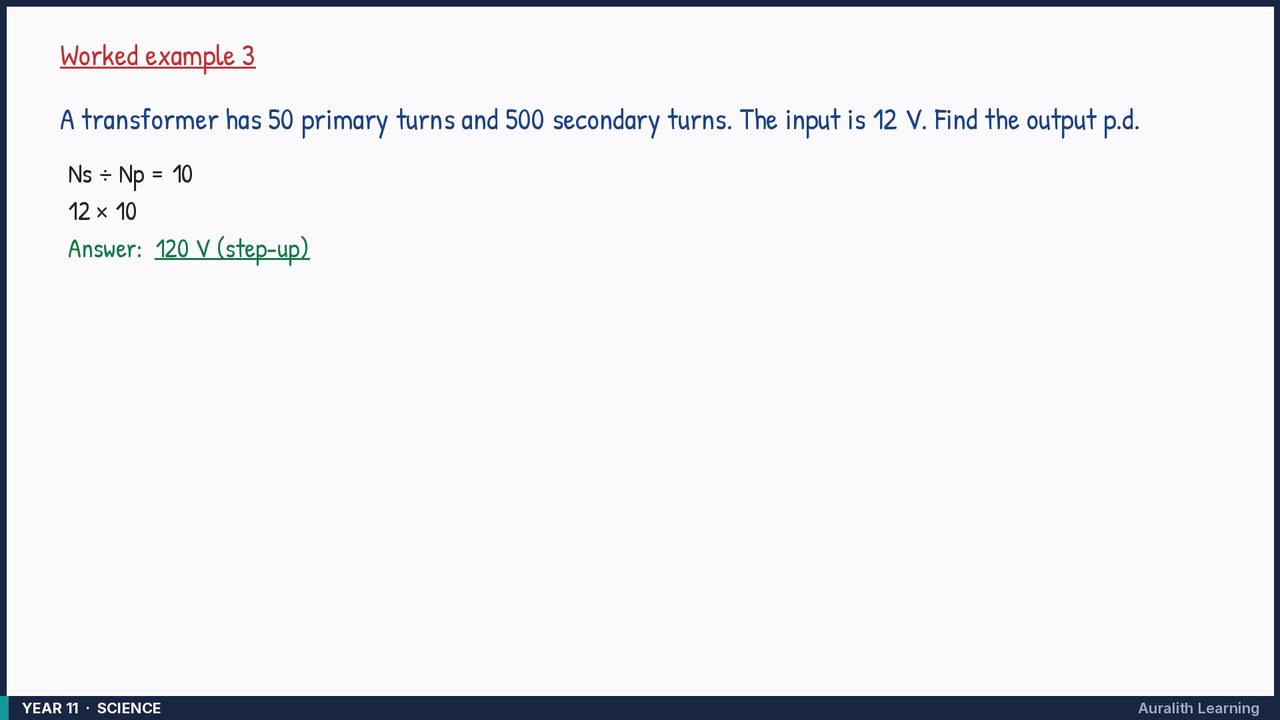
A transformer has 50 primary turns and 500 secondary turns. The input is 12 V. Find the output p.d.
- Step 1: Ns ÷ Np = 10
- Step 2: 12 × 10
Answer: 120 V (step-up)