Year 11 (ages 15–16, Grade 10 in the US) · Physical education · Sport psychology and society · Lesson 1
Sport psychology: skills, goals, feedback and arousal
Classifying skills, setting SMART targets, types of guidance and feedback, the inverted-U theory of arousal, mental preparation techniques, and intrinsic and extrinsic motivation.
Exam boards: this lesson matches the AQA and Pearson Edexcel GCSE physical education courses. Check which course your school follows.
8-minute video lesson
Teaching, worked examples and 20 practice questions solved step by step.
Watch free for a monthWhat your child will learn
- Classify skills on continua
- Set SMART targets
- Describe types of guidance and feedback
- Explain arousal and mental preparation
The method
- Classify: open–closed, basic–complex, low–high organisation.
- SMART: specific, measurable, achievable, realistic, time-bound.
- Feedback: intrinsic/extrinsic; positive/negative; results/performance.
- Inverted-U: performance best at moderate arousal.
Key words: skill classification, SMART, feedback, arousal, motivation.
Worked examples
Worked examples from the lesson, with every step.
Question 1
Is a golf putt an open or closed skill?
- Step 1: Not affected by others; performer controls it.
Answer: closed
Question 2
Make this SMART: ‘I want to get fitter.’
- Step 1: Name a test and amount.
- Step 2: Add a deadline.
Answer: e.g. ‘Increase my bleep test level by 2 in 6 weeks.’
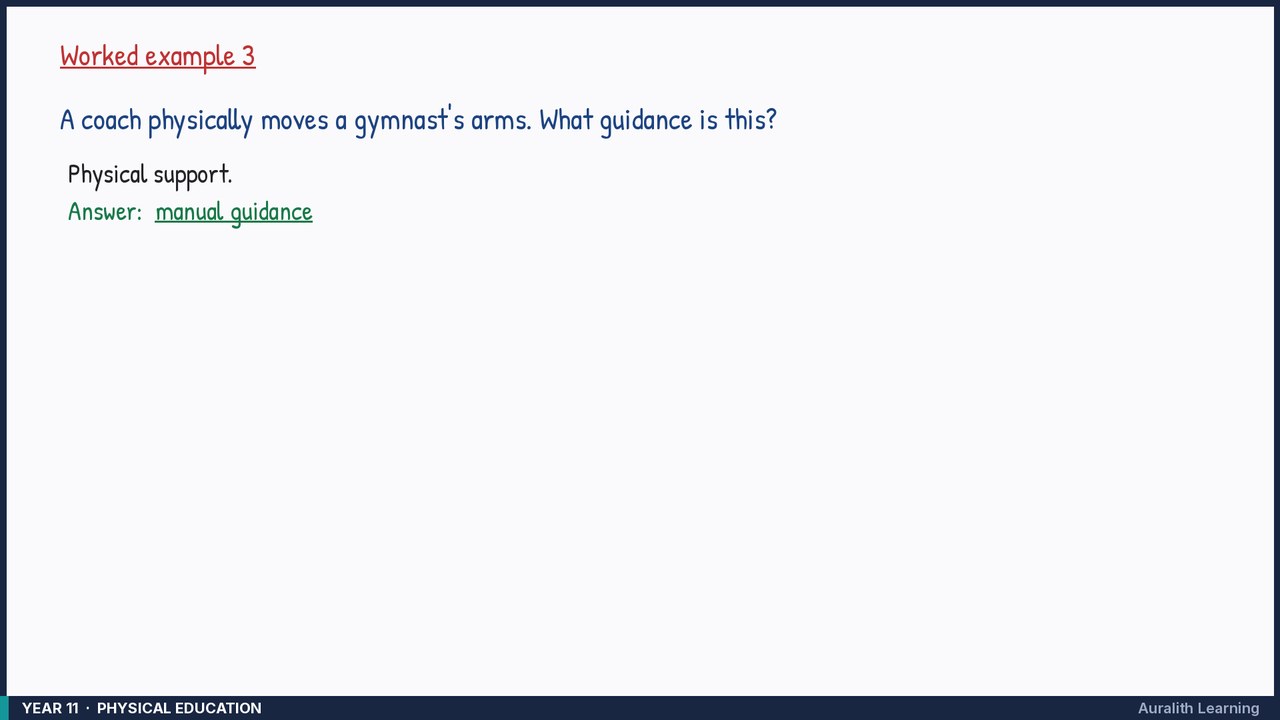
Question 3
A coach physically moves a gymnast's arms. What guidance is this?
- Step 1: Physical support.
Answer: manual guidance