Year 11 (ages 15–16, Grade 10 in the US) · Physical education · Sport psychology and society · Lesson 2
Sport and society: participation, commercialisation and ethics
Factors affecting participation in sport, the commercialisation of sport and the ‘golden triangle’ of sport, media and sponsorship, sporting ethics including sportsmanship and gamesmanship, and the use of performance-enhancing drugs.
Exam boards: this lesson matches the AQA and Pearson Edexcel GCSE physical education courses. Check which course your school follows.
8-minute video lesson
Teaching, worked examples and 20 practice questions solved step by step.
Watch free for a monthWhat your child will learn
- Explain factors affecting participation
- Explain the golden triangle
- Evaluate the effects of commercialisation
- Discuss ethics, including drugs in sport
The method
- Participation is affected by age, gender, disability, cost, family and role models.
- Golden triangle: sport, media and sponsors depend on each other.
- Sportsmanship: fair play. Gamesmanship: bending rules to gain an advantage.
- PEDs are banned: they are unfair and can harm health.
Key words: participation, commercialisation, sponsorship, sportsmanship, performance-enhancing drugs.
Worked examples
Worked examples from the lesson, with every step.
Question 1
Give two factors that might stop someone taking part in sport.
- Step 1: Equipment or fees are expensive.
- Step 2: No local facilities.
Answer: cost and lack of facilities
Question 2
Explain the golden triangle.
- Step 1: Media and sponsors pay sport; sport gives them audiences and exposure.
Answer: sport, media and sponsors depend on each other
Question 3
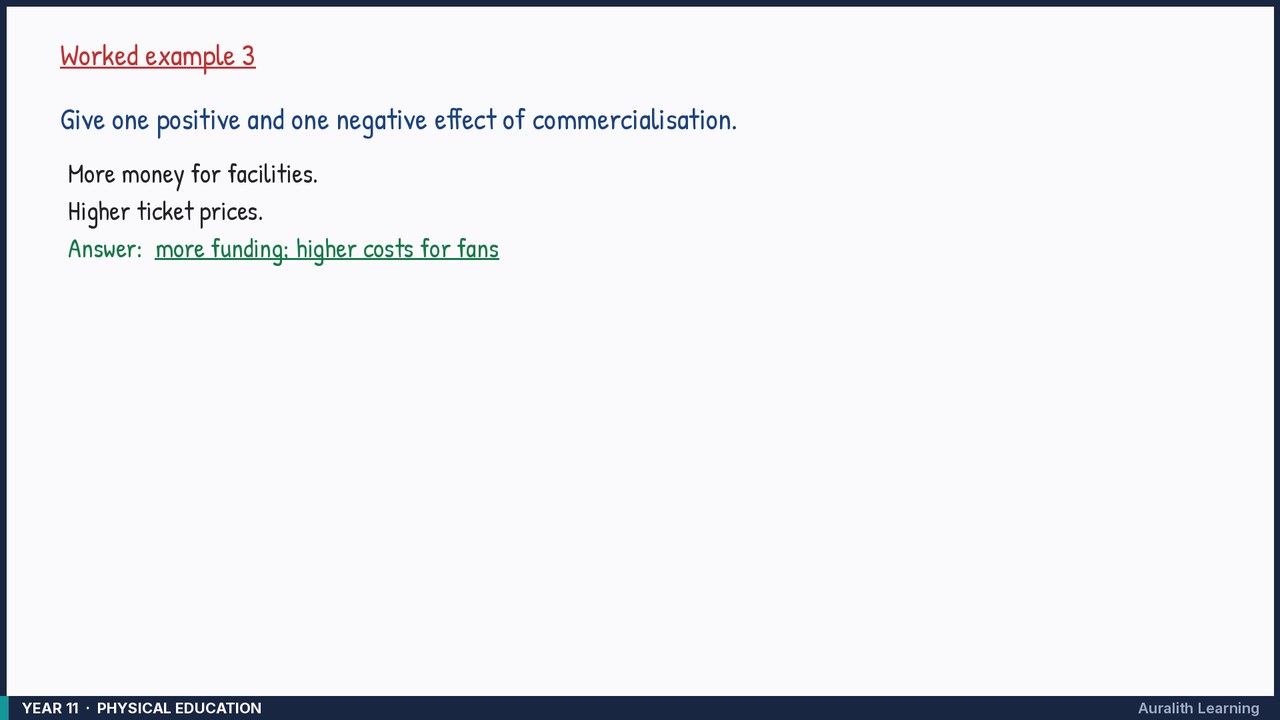
Give one positive and one negative effect of commercialisation.
- Step 1: More money for facilities.
- Step 2: Higher ticket prices.
Answer: more funding; higher costs for fans