Year 11 (ages 15–16, Grade 10 in the US) · Maths · Surds (Higher) · Lesson 1
Simplifying surds
What a surd is, simplifying surds using square factors, multiplying surds, adding and subtracting like surds, and expanding brackets containing surds.
Exam boards: this lesson matches the AQA and Pearson Edexcel GCSE maths courses. Check which course your school follows.
8-minute video lesson
Teaching, worked examples and 20 practice questions solved step by step.
Watch free for a monthWhat your child will learn
- Understand what a surd is
- Simplify surds using square factors
- Add, subtract and multiply surds
- Expand brackets containing surds
The method
- √(ab) = √a × √b.
- Find the largest square factor: √12 = √4 × √3 = 2√3.
- Only like surds can be added: 3√2 + 5√2 = 8√2.
- √a × √a = a.
Key words: surd, square factor, simplify, exact, expand.
Worked examples
Worked examples from the lesson, with every step.
Question 1
Simplify √48.
- Step 1: 48 = 16 × 3
- Step 2: √16 × √3
Answer: 4√3
Question 2
Simplify √50 − √8.
- Step 1: 5√2 − 2√2
- Step 2: 3√2
Answer: 3√2
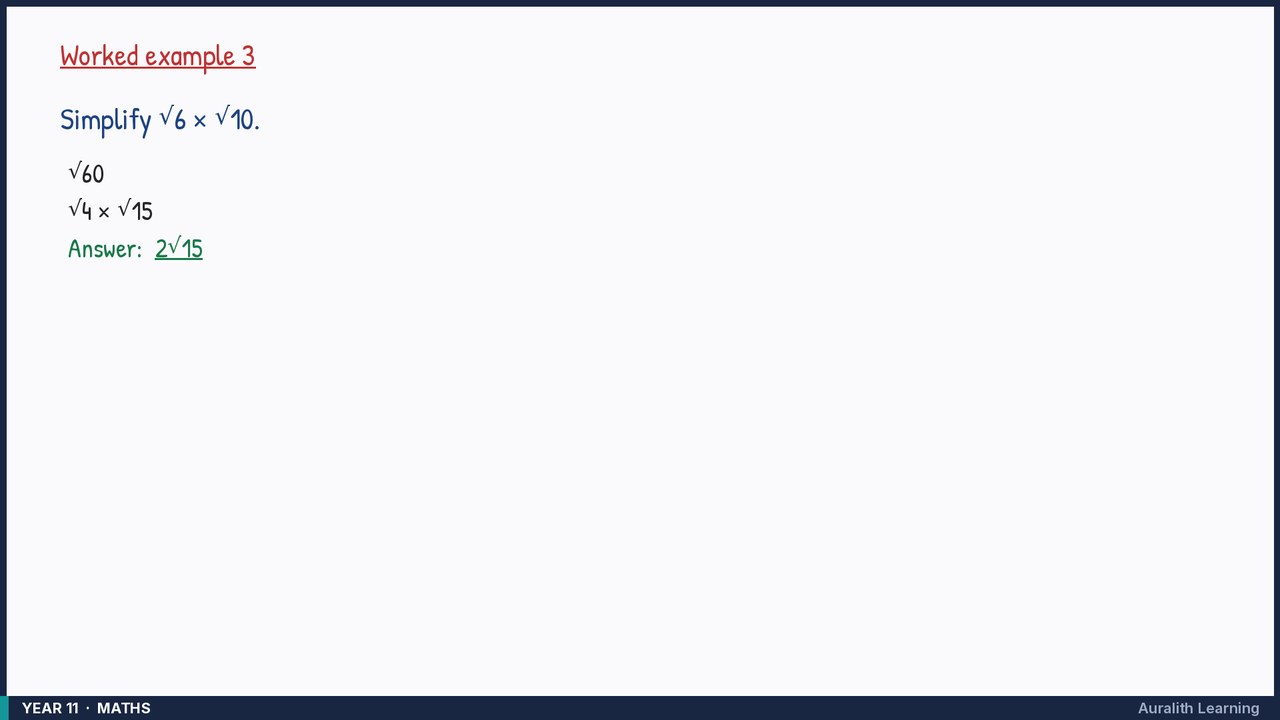
Question 3
Simplify √6 × √10.
- Step 1: √60
- Step 2: √4 × √15
Answer: 2√15