Year 11 (ages 15–16, Grade 10 in the US) · Maths · Surds (Higher) · Lesson 2
Rationalising the denominator
Removing surds from the denominator of a fraction: multiplying by the surd for single-term denominators, and by the conjugate for denominators such as 3 − √5, then simplifying fully.
Exam boards: this lesson matches the AQA and Pearson Edexcel GCSE maths courses. Check which course your school follows.
8-minute video lesson
Teaching, worked examples and 20 practice questions solved step by step.
Watch free for a monthWhat your child will learn
- Rationalise a denominator like √a
- Rationalise a denominator like a ± √b
- Simplify the result fully
- Use surds in exact-answer problems
The method
- Denominator √a: multiply top and bottom by √a.
- Denominator a + √b: multiply top and bottom by a − √b (the conjugate).
- (a + √b)(a − √b) = a² − b, which has no surd.
- Simplify fully.
Key words: rationalise, denominator, conjugate, surd, exact.
Worked examples
Worked examples from the lesson, with every step.
Question 1
Rationalise 1/√3.
- Step 1: × √3/√3
- Step 2: √3/3
Answer: √3/3
Question 2
Rationalise 12/√6.
- Step 1: 12√6/6
- Step 2: 2√6
Answer: 2√6
Question 3
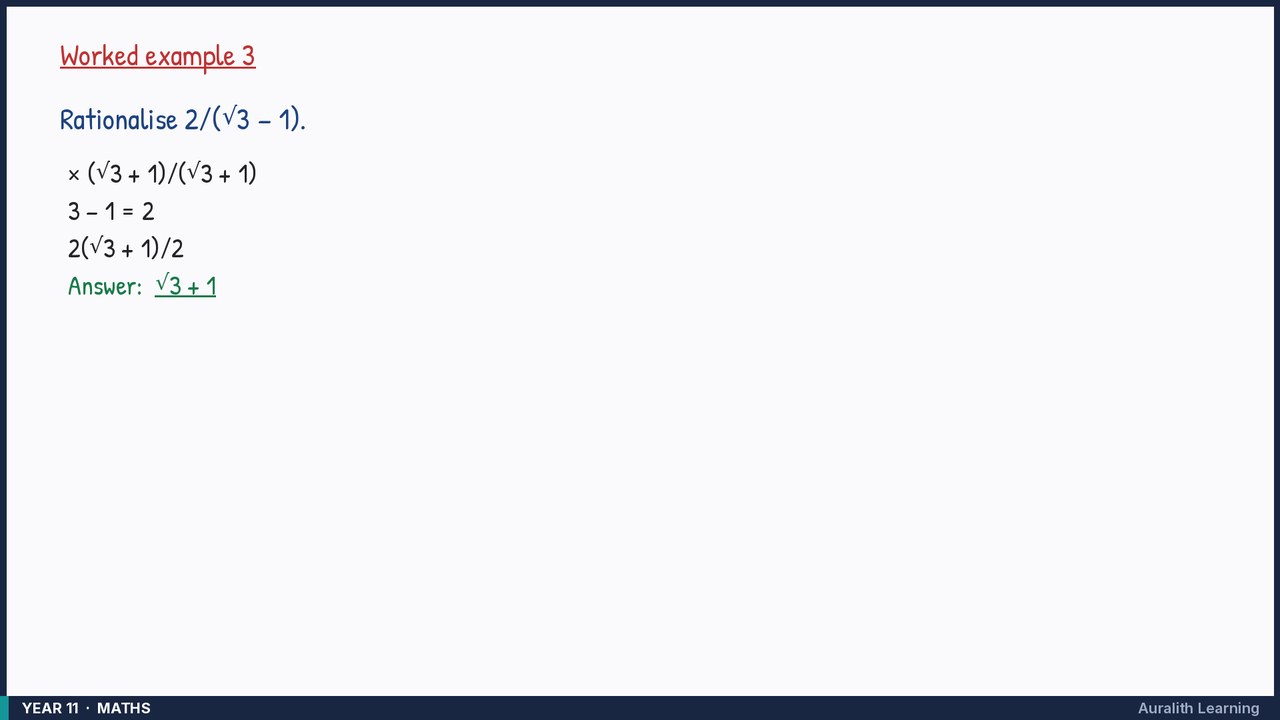
Rationalise 2/(√3 − 1).
- Step 1: × (√3 + 1)/(√3 + 1)
- Step 2: 3 − 1 = 2
- Step 3: 2(√3 + 1)/2
Answer: √3 + 1