Year 11 (ages 15–16, Grade 10 in the US) · Maths · Sequences and proof · Lesson 1
Quadratic sequences: the nth term
Recognising quadratic sequences from a constant second difference, finding the nth term an² + bn + c, using the nth term to find terms and test whether a number is in a sequence, and recognising other special sequences.
Exam boards: this lesson matches the AQA and Pearson Edexcel GCSE maths courses. Check which course your school follows.
9-minute video lesson
Teaching, worked examples and 20 practice questions solved step by step.
Watch free for a monthWhat your child will learn
- Recognise a quadratic sequence
- Find the nth term of a quadratic sequence
- Use the nth term to find and test terms
- Recognise Fibonacci-type and geometric sequences
The method
- Find the first and second differences.
- Halve the second difference: that's a, the coefficient of n².
- Subtract an² from each term.
- Find the linear nth term of what is left, and add it on.
Key words: quadratic sequence, second difference, nth term, coefficient, geometric.
Worked examples
Worked examples from the lesson, with every step.
Question 1
Find the nth term of 3, 9, 19, 33, 51.
- Step 1: 6, 10, 14, 18; second: 4
- Step 2: 4 ÷ 2 = 2 → 2n²: 2, 8, 18, 32, 50
- Step 3: 1, 1, 1, 1, 1
Answer: 2n² + 1
Question 2
Find the nth term of 2, 6, 12, 20, 30.
- Step 1: 2 → n²
- Step 2: 1, 2, 3, 4, 5 → n
Answer: n² + n
Question 3
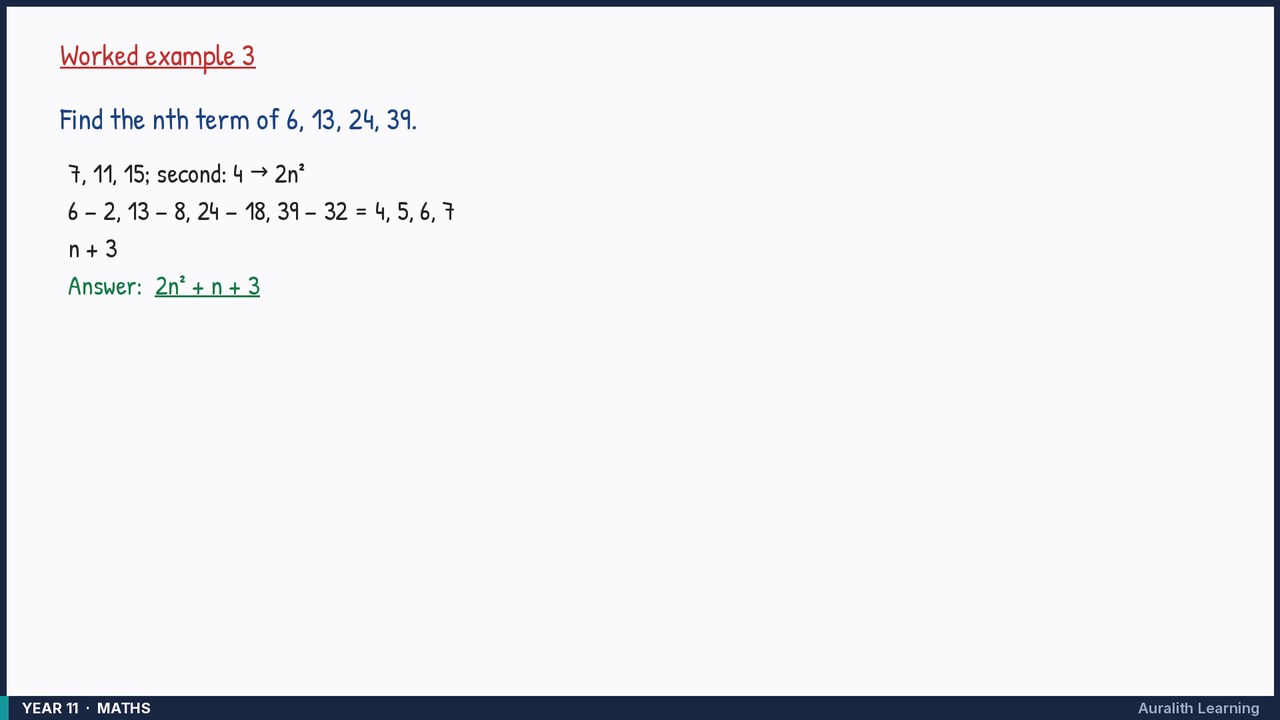
Find the nth term of 6, 13, 24, 39.
- Step 1: 7, 11, 15; second: 4 → 2n²
- Step 2: 6 − 2, 13 − 8, 24 − 18, 39 − 32 = 4, 5, 6, 7
- Step 3: n + 3
Answer: 2n² + n + 3