Year 11 (ages 15–16, Grade 10 in the US) · Maths · Sequences and proof · Lesson 2
Algebraic proof
Writing even, odd and consecutive numbers algebraically, proving statements about numbers using algebra, proving identities, and disproving statements with a counterexample.
Exam boards: this lesson matches the AQA and Pearson Edexcel GCSE maths courses. Check which course your school follows.
9-minute video lesson
Teaching, worked examples and 20 practice questions solved step by step.
Watch free for a monthWhat your child will learn
- Write even, odd and consecutive numbers algebraically
- Prove statements about numbers
- Prove algebraic identities
- Disprove a statement using a counterexample
The method
- Even: 2n. Odd: 2n + 1. Consecutive: n, n + 1, n + 2.
- Write the statement in algebra.
- Expand and simplify.
- Show the result has the required form, e.g. 4(…) for a multiple of 4.
Key words: proof, identity, consecutive, counterexample, multiple.
Worked examples
Worked examples from the lesson, with every step.
Question 1
Prove that the sum of three consecutive integers is a multiple of 3.
- Step 1: n + (n + 1) + (n + 2)
- Step 2: 3n + 3 = 3(n + 1)
- Step 3: 3 × integer
Answer: 3(n + 1) is always a multiple of 3
Question 2
Prove that the square of an odd number is odd.
- Step 1: (2n + 1)² = 4n² + 4n + 1
- Step 2: = 2(2n² + 2n) + 1
- Step 3: 2 × integer + 1
Answer: 2(2n² + 2n) + 1 is odd
Question 3
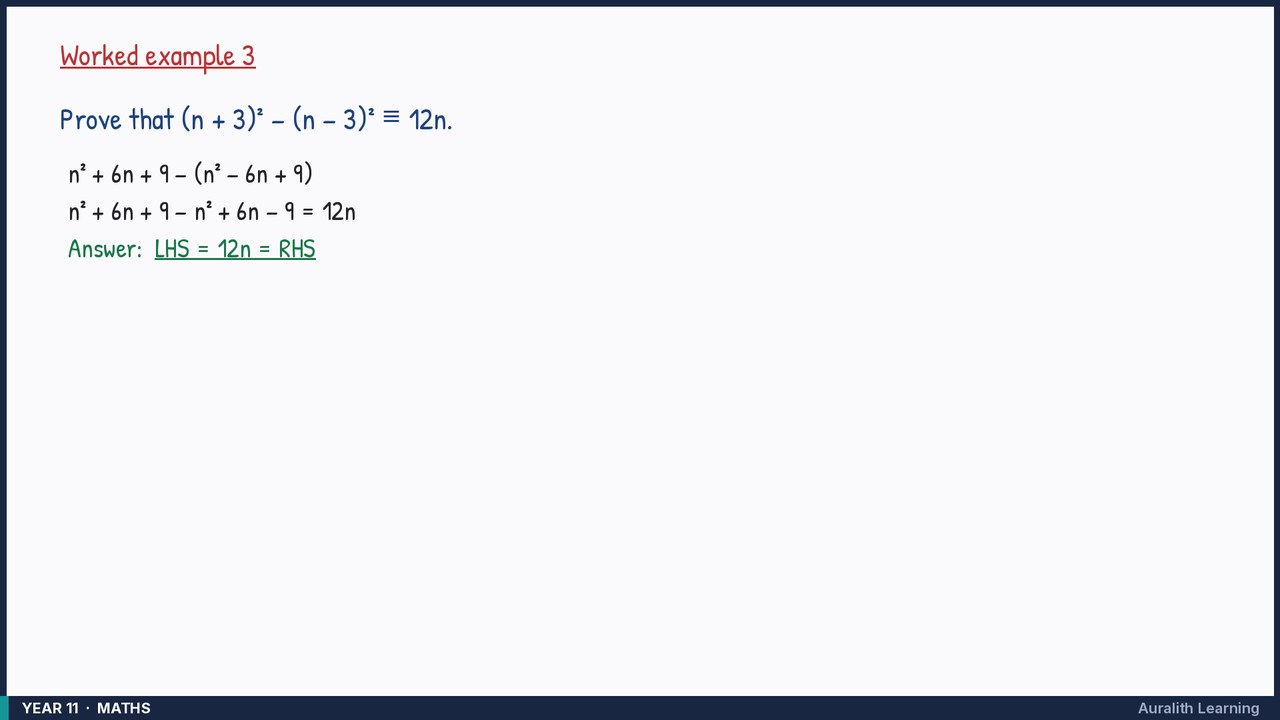
Prove that (n + 3)² − (n − 3)² ≡ 12n.
- Step 1: n² + 6n + 9 − (n² − 6n + 9)
- Step 2: n² + 6n + 9 − n² + 6n − 9 = 12n
Answer: LHS = 12n = RHS