Year 11 (ages 15–16, Grade 10 in the US) · Maths · Higher algebra · Lesson 4
Functions: composite and inverse
Function notation, substituting into functions, solving equations involving functions, finding composite functions such as fg(x), and finding inverse functions f⁻¹(x).
Exam boards: this lesson matches the AQA and Pearson Edexcel GCSE maths courses. Check which course your school follows.
10-minute video lesson
Teaching, worked examples and 20 practice questions solved step by step.
Watch free for a monthWhat your child will learn
- Use function notation
- Find composite functions
- Find inverse functions
- Solve equations involving functions
The method
- f(a): replace x with a.
- fg(x) = f(g(x)): do g first, then f.
- Inverse: write y = f(x), swap x and y, rearrange for y.
- Check: f⁻¹ undoes f.
Key words: function, input, output, composite function, inverse function.
Worked examples
Worked examples from the lesson, with every step.
Question 1
f(x) = 2x + 5. Find f(3) and f(−4).
- Step 1: 2 × 3 + 5 = 11
- Step 2: 2 × −4 + 5 = −3
Answer: f(3) = 11, f(−4) = −3
Question 2
f(x) = 2x + 5. Find f⁻¹(x).
- Step 1: x = 2y + 5
- Step 2: x − 5 = 2y
Answer: f⁻¹(x) = (x − 5)/2
Question 3
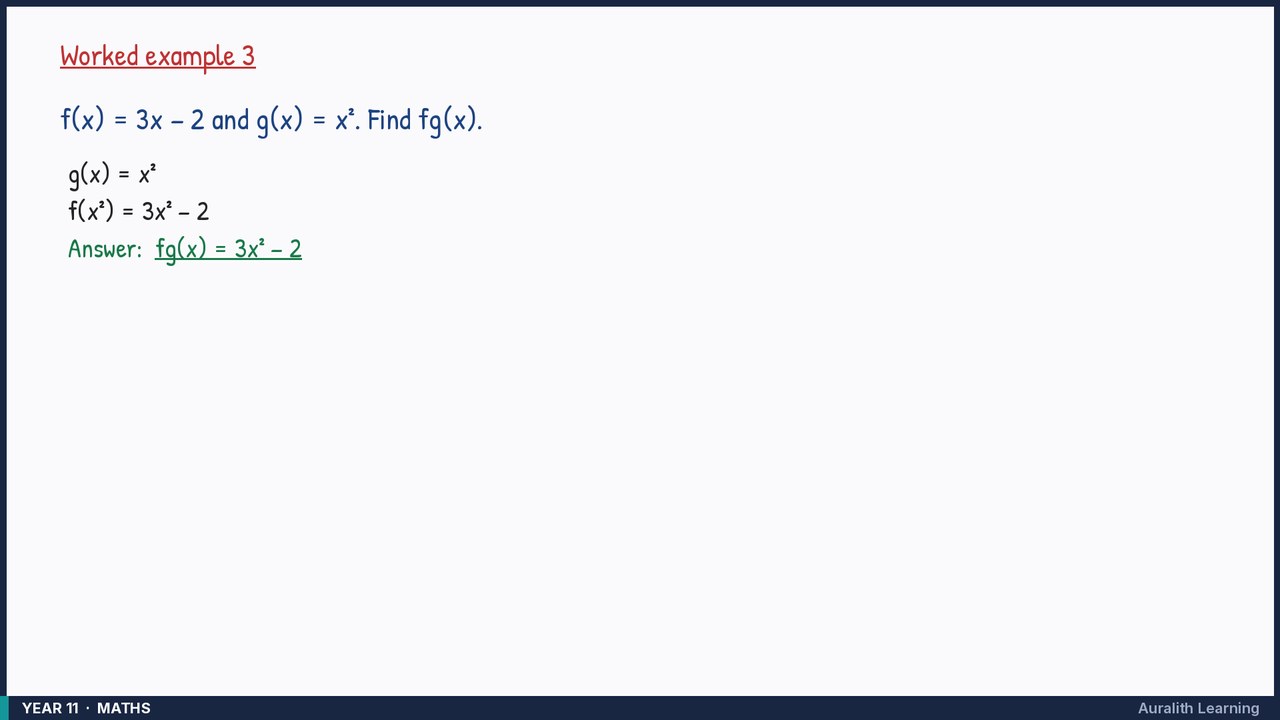
f(x) = 3x − 2 and g(x) = x². Find fg(x).
- Step 1: g(x) = x²
- Step 2: f(x²) = 3x² − 2
Answer: fg(x) = 3x² − 2