Year 11 (ages 15–16, Grade 10 in the US) · Maths · Higher algebra · Lesson 2
Completing the square
Writing quadratics in the form (x + p)² + q, finding turning points and minimum values, completing the square when the coefficient of x² is not 1, and solving quadratic equations in surd form.
Exam boards: this lesson matches the AQA and Pearson Edexcel GCSE maths courses. Check which course your school follows.
10-minute video lesson
Teaching, worked examples and 20 practice questions solved step by step.
Watch free for a monthWhat your child will learn
- Write x² + bx + c as (x + p)² + q
- Find the turning point of a quadratic
- Complete the square when a ≠ 1
- Solve quadratics by completing the square
The method
- Halve the coefficient of x: that's p.
- Write (x + p)², then subtract p².
- Add the constant to get q.
- Turning point is (−p, q).
Key words: completing the square, turning point, minimum, surd form, line of symmetry.
Worked examples
Worked examples from the lesson, with every step.
Question 1
Write x² + 10x + 7 in the form (x + p)² + q
- Step 1: 10 ÷ 2 = 5
- Step 2: (x + 5)² − 25 + 7
Answer: (x + 5)² − 18
Question 2
Find the turning point of y = x² − 6x + 11
- Step 1: (x − 3)² − 9 + 11 = (x − 3)² + 2
- Step 2: Turning point (3, 2)
Answer: (3, 2)
Question 3
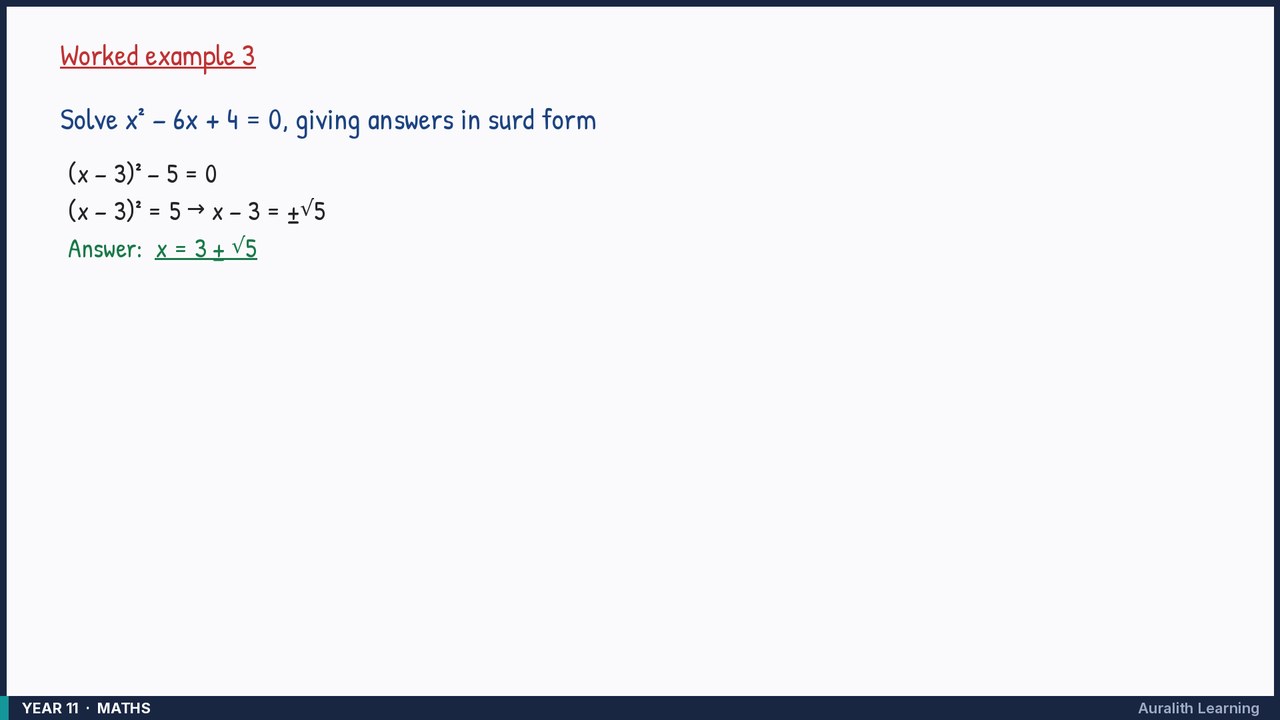
Solve x² − 6x + 4 = 0, giving answers in surd form
- Step 1: (x − 3)² − 5 = 0
- Step 2: (x − 3)² = 5 → x − 3 = ±√5
Answer: x = 3 ± √5