Year 11 (ages 15–16, Grade 10 in the US) · English · A Christmas Carol · Lesson 2
Staves Two and Three: the Ghosts of Christmas Past and Present
How the Ghosts of Christmas Past and Present begin to change Scrooge: his lonely childhood, Fezziwig's party, Belle's farewell, the Cratchit family's Christmas, Tiny Tim, and the children Ignorance and Want.
Exam boards: this lesson matches the AQA and Pearson Edexcel GCSE English courses. Check which course your school follows.
8-minute video lesson
Teaching, worked examples and 20 practice questions solved step by step.
Watch free for a monthWhat your child will learn
- Explain what Scrooge learns from his past
- Analyse the Cratchits and Tiny Tim
- Analyse Ignorance and Want
- Track the early stages of Scrooge's change
The method
- Past: Scrooge sees himself as a lonely boy; he begins to feel.
- Fezziwig: a kind employer — a contrast to Scrooge.
- Present: the Cratchits are poor but loving.
- Ignorance and Want: Dickens warns society.
Key words: memory, contrast, symbolism, empathy, redemption.
Worked examples
Worked examples from the lesson, with every step.
Question 1
Why is the Ghost of Christmas Past described as both a child and an old man?
- Step 1: Memories can be from youth but feel old and distant.
- Step 2: It suggests the past is always with us.
Answer: it represents memory, both young and old
Question 2
How does Fezziwig act as a contrast to Scrooge?
- Step 1: Generous: he throws a party for his workers.
- Step 2: Mean: Bob has a tiny fire.
Answer: a kind employer versus a mean one
Question 3
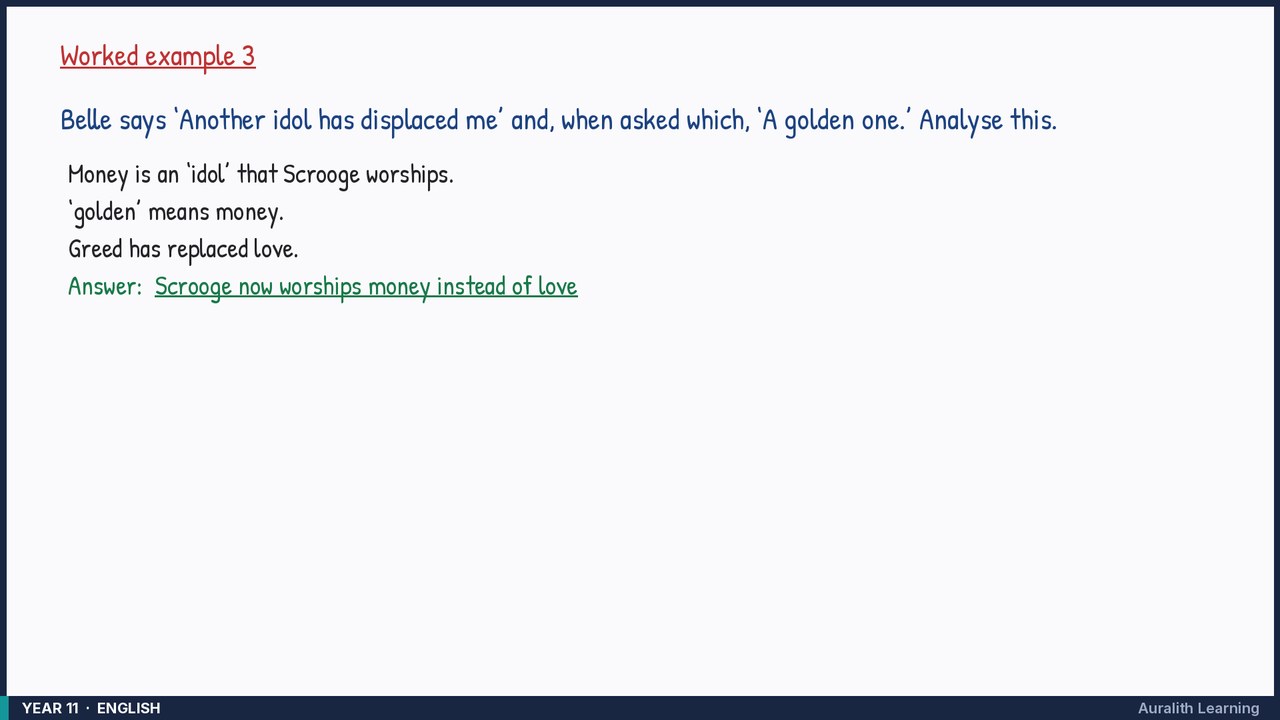
Belle says ‘Another idol has displaced me’ and, when asked which, ‘A golden one.’ Analyse this.
- Step 1: Money is an ‘idol’ that Scrooge worships.
- Step 2: ‘golden’ means money.
- Step 3: Greed has replaced love.
Answer: Scrooge now worships money instead of love