Year 11 (ages 15–16, Grade 10 in the US) · English · A Christmas Carol · Lesson 1
Context and Stave One: Scrooge and Marley
The Victorian context of A Christmas Carol, including the Poor Law, workhouses and Dickens's concern for the poor, and how Stave One presents Scrooge as cold and miserly, with Marley's ghost as a warning.
Exam boards: this lesson matches the AQA and Pearson Edexcel GCSE English courses. Check which course your school follows.
9-minute video lesson
Teaching, worked examples and 20 practice questions solved step by step.
Watch free for a monthWhat your child will learn
- Explain key Victorian context
- Analyse how Dickens presents Scrooge in Stave One
- Explain the purpose of Marley's ghost
- Link context to Dickens's message
The method
- Context: published 1843, during great poverty.
- Scrooge: cold imagery, lists of harsh adjectives.
- Marley: the chain he ‘forged in life’ — a warning.
- Dickens's purpose: to change readers' attitudes.
Key words: novella, Poor Law, workhouse, miser, allegory.
Worked examples
Worked examples from the lesson, with every step.
Question 1
Analyse ‘solitary as an oyster’.
- Step 1: A simile.
- Step 2: An oyster is hard and closed on the outside.
- Step 3: Scrooge shuts other people out; perhaps there is something good hidden inside.
Answer: Scrooge is closed off, but may have hidden goodness
Question 2
What does the list ‘squeezing, wrenching, grasping…’ suggest?
- Step 1: A list of verbs.
- Step 2: Each one shows him holding on to money tightly; the build-up exaggerates his greed.
Answer: Scrooge's extreme greed
Question 3
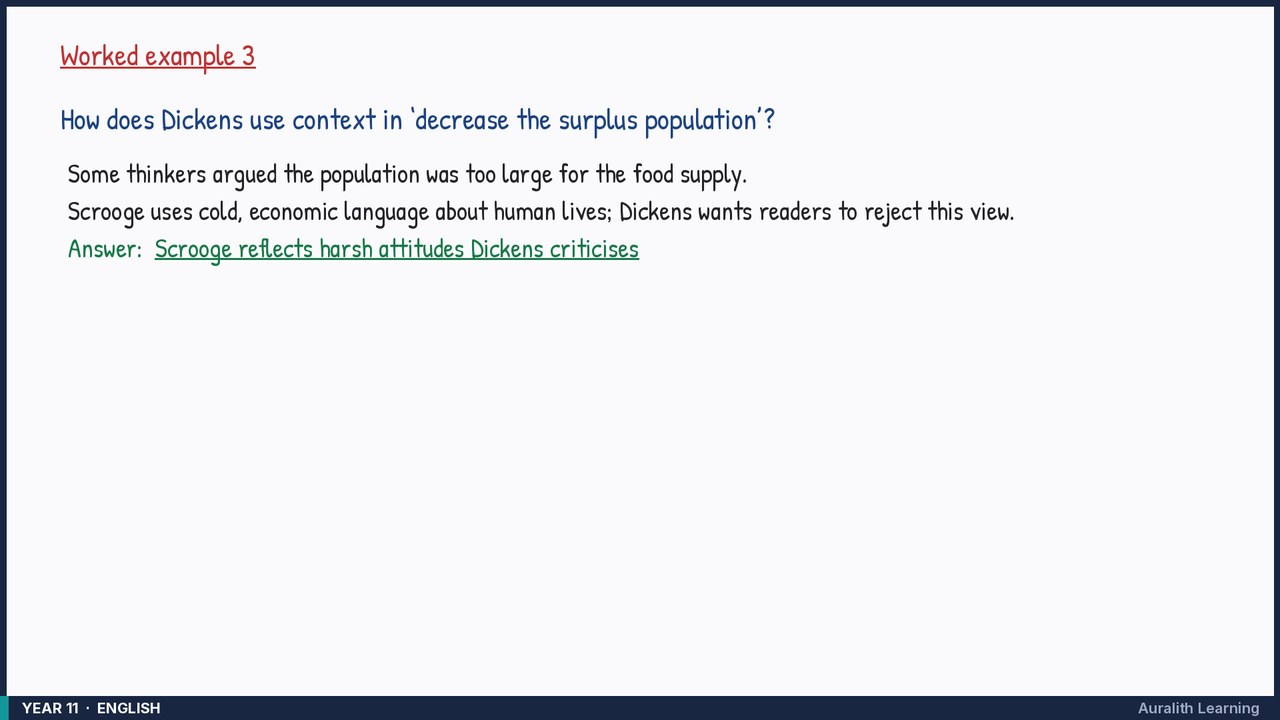
How does Dickens use context in ‘decrease the surplus population’?
- Step 1: Some thinkers argued the population was too large for the food supply.
- Step 2: Scrooge uses cold, economic language about human lives; Dickens wants readers to reject this view.
Answer: Scrooge reflects harsh attitudes Dickens criticises