Year 11 (ages 15–16, Grade 10 in the US) · Design and technology · NEA and sustainability · Lesson 1
The NEA: an iterative design process
How the design and technology non-exam assessment works: investigating a context, writing a design brief and specification, generating and developing ideas iteratively, making a prototype, and testing and evaluating it.
Exam boards: this lesson matches the AQA and Pearson Edexcel GCSE design and technology courses. Check which course your school follows.
8-minute video lesson
Teaching, worked examples and 20 practice questions solved step by step.
Watch free for a monthWhat your child will learn
- Describe the stages of the NEA
- Write a design brief and specification
- Explain iterative design
- Test and evaluate a prototype
The method
- Investigate the context and the user's needs.
- Write a brief and a measurable specification.
- Design, model, test, improve — and repeat.
- Make a prototype; test it against the specification.
Key words: context, design brief, specification, iterative design, prototype.
Worked examples
Worked examples from the lesson, with every step.
Question 1
What is the difference between a design brief and a specification?
- Step 1: A short statement of the problem.
- Step 2: Detailed, measurable requirements.
Answer: brief: the problem; specification: measurable requirements
Question 2
Make this specification point measurable: ‘It should be light.’
- Step 1: Add a value and unit.
- Step 2: It must weigh less than 300 g.
Answer: ‘It must weigh less than 300 g.’
Question 3
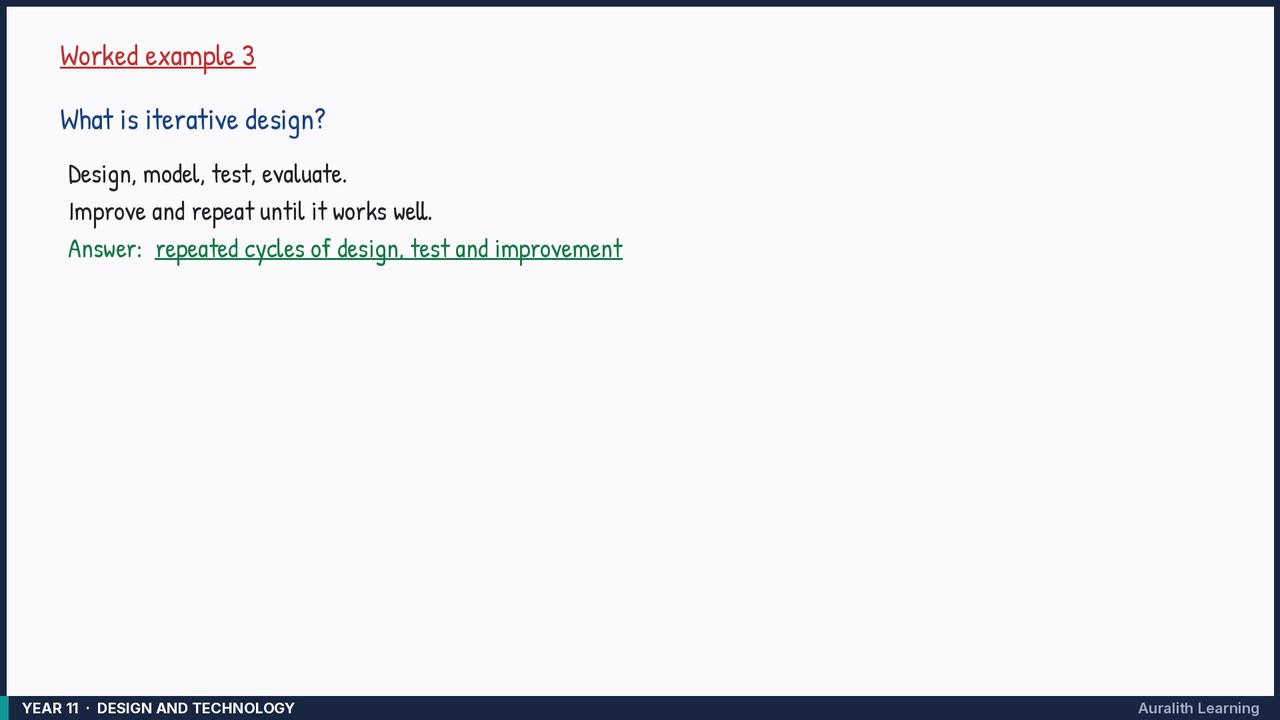
What is iterative design?
- Step 1: Design, model, test, evaluate.
- Step 2: Improve and repeat until it works well.
Answer: repeated cycles of design, test and improvement