Year 11 (ages 15–16, Grade 10 in the US) · Design and technology · NEA and sustainability · Lesson 2
Sustainability, the 6 Rs and life cycle assessment
How designers reduce the environmental impact of products: finite and non-finite resources, the 6 Rs, life cycle assessment, the carbon footprint of products, the circular economy and ethical design.
Exam boards: this lesson matches the AQA and Pearson Edexcel GCSE design and technology courses. Check which course your school follows.
8-minute video lesson
Teaching, worked examples and 20 practice questions solved step by step.
Watch free for a monthWhat your child will learn
- Distinguish finite and non-finite resources
- Apply the 6 Rs
- Explain life cycle assessment
- Evaluate products for sustainability
The method
- Finite resources will run out (e.g. oil, metal ores).
- 6 Rs: reduce, reuse, recycle, rethink, refuse, repair.
- Life cycle: raw materials → manufacture → use → disposal.
- Design for disassembly, repair and recycling.
Key words: finite resource, 6 Rs, life cycle assessment, carbon footprint, circular economy.
Worked examples
Worked examples from the lesson, with every step.
Question 1
Is crude oil finite or non-finite?
- Step 1: It took millions of years to form.
Answer: finite
Question 2
Give an example of reuse.
- Step 1: Using a glass jar as a storage container.
Answer: e.g. reusing a jar for storage
Question 3
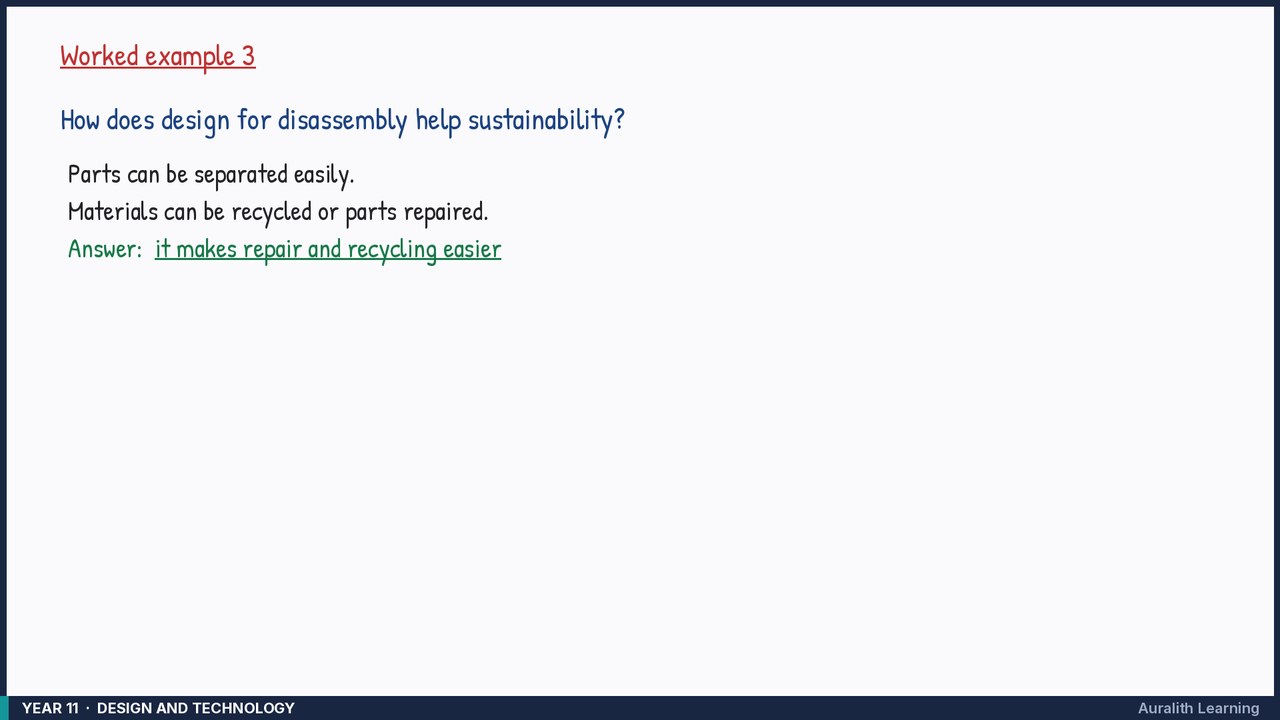
How does design for disassembly help sustainability?
- Step 1: Parts can be separated easily.
- Step 2: Materials can be recycled or parts repaired.
Answer: it makes repair and recycling easier