Year 11 (ages 15–16, Grade 10 in the US) · Computing · GCSE revision and exam skills · Lesson 3
Paper 1 calculations: number bases, file sizes and units
Revising the calculations on the computer systems paper: converting between binary, denary and hexadecimal, binary addition and shifts, units of data, and calculating image, sound and text file sizes.
Exam boards: this lesson matches the Pearson Edexcel GCSE computing courses. Check which course your school follows.
9-minute video lesson
Teaching, worked examples and 20 practice questions solved step by step.
Watch free for a monthWhat your child will learn
- Convert between binary, denary and hexadecimal
- Add binary numbers and perform shifts
- Convert between units of data
- Calculate image, sound and text file sizes
The method
- Binary place values: 128, 64, 32, 16, 8, 4, 2, 1.
- Hex: split binary into 4-bit nibbles.
- Image: width × height × colour depth (bits).
- Sound: sample rate × bit depth × seconds (bits); ÷ 8 for bytes.
Key words: binary, hexadecimal, bit depth, sample rate, file size.
Worked examples
Worked examples from the lesson, with every step.
Question 1
Convert 01001101 to denary.
- Step 1: 64 + 8 + 4 + 1
Answer: 77
Question 2
Convert 200 to binary.
- Step 1: 200 = 128 + 64 + 8
Answer: 11001000
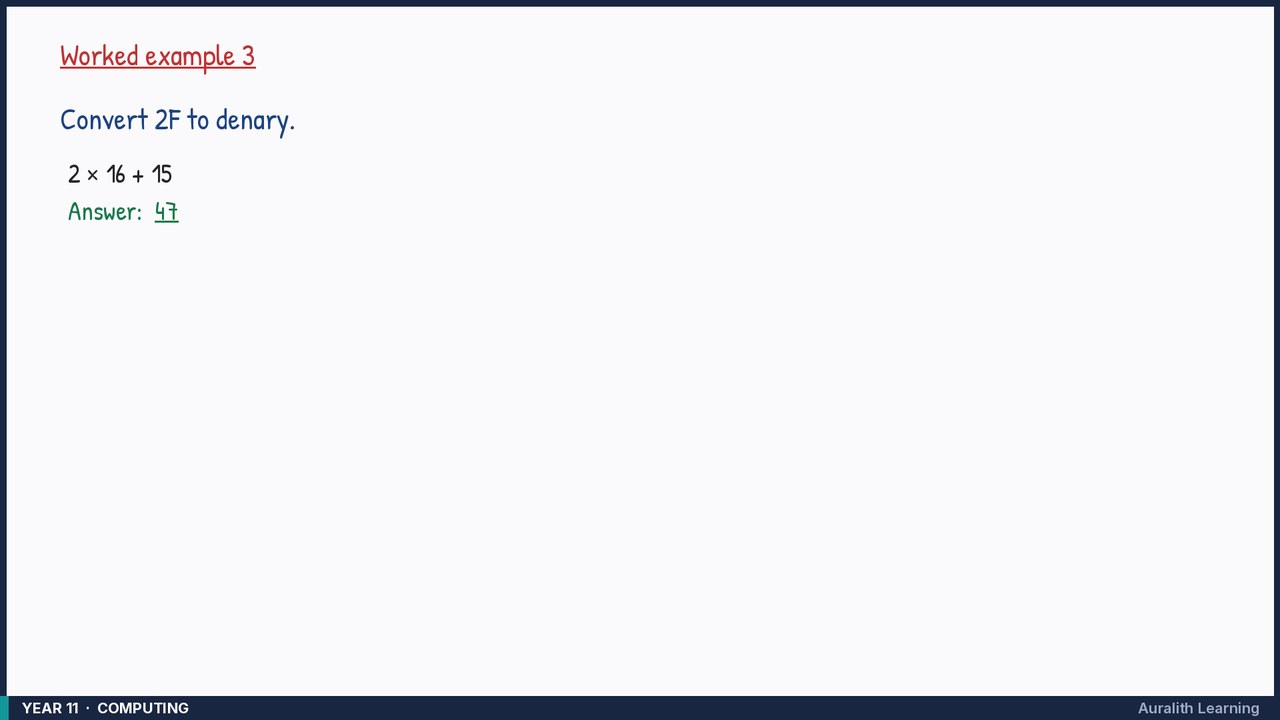
Question 3
Convert 2F to denary.
- Step 1: 2 × 16 + 15
Answer: 47