Year 11 (ages 15–16, Grade 10 in the US) · Computing · GCSE revision and exam skills · Lesson 2
Computational thinking, flowcharts and pseudocode
Revising abstraction, decomposition and algorithmic thinking, reading and drawing flowcharts, writing and tracing pseudocode, and using trace tables to find the output of an algorithm.
Exam boards: this lesson matches the AQA and Pearson Edexcel GCSE computing courses. Check which course your school follows.
8-minute video lesson
Teaching, worked examples and 20 practice questions solved step by step.
Watch free for a monthWhat your child will learn
- Explain abstraction and decomposition
- Read and draw flowcharts
- Write pseudocode for simple algorithms
- Use trace tables
The method
- Abstraction: remove unnecessary detail.
- Decomposition: break a problem into smaller parts.
- Flowchart symbols: terminator, process, decision, input/output.
- Trace table: record each variable after each step.
Key words: abstraction, decomposition, flowchart, pseudocode, trace table.
Worked examples
Worked examples from the lesson, with every step.
Question 1
Give an example of abstraction.
- Step 1: A map of the London Underground shows stations and lines, not real distances.
Answer: a train map that leaves out real distances
Question 2
Which flowchart symbol shows a decision?
- Step 1: A diamond.
Answer: a diamond
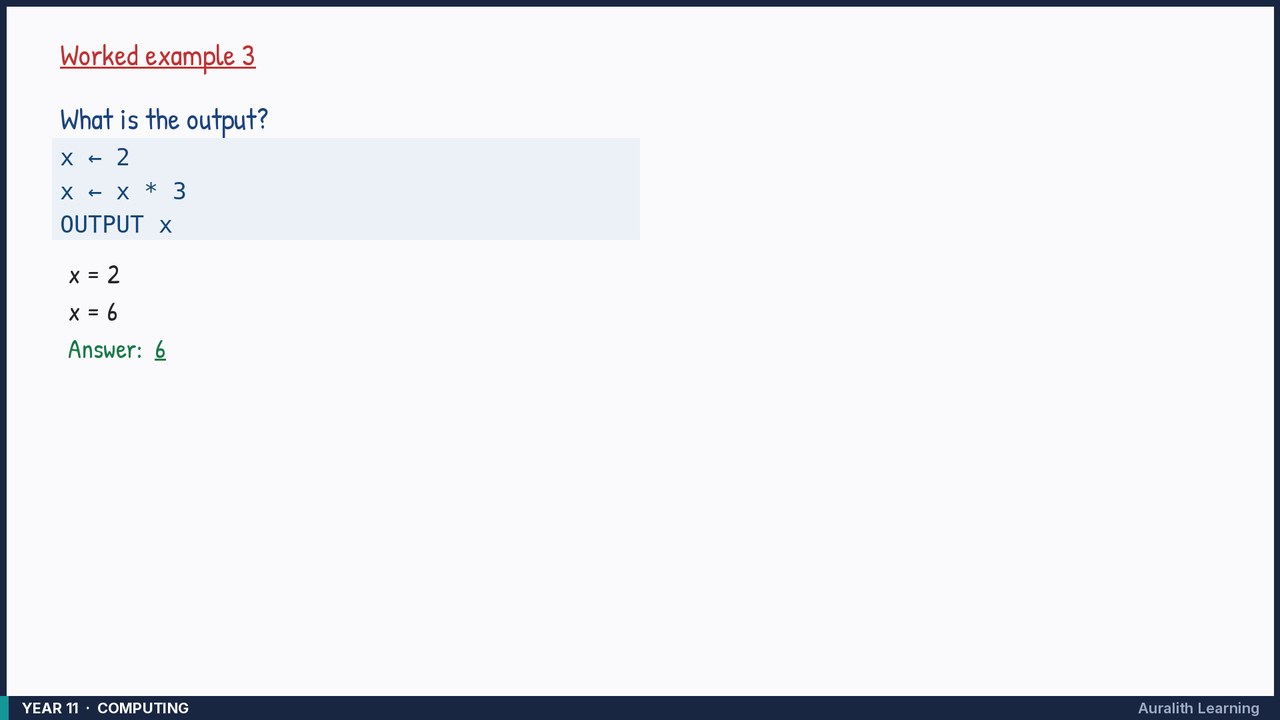
Question 3
What is the output? c:x ← 2 c:x ← x * 3 c:OUTPUT x
- Step 1: x = 2
- Step 2: x = 6
Answer: 6