Year 10 (ages 14–15, Grade 9 in the US) · Science · Physics: waves and the EM spectrum · Lesson 1
Wave properties and the wave equation
Transverse and longitudinal waves, amplitude, wavelength, frequency and period, and calculating wave speed with v = f × λ and v = x ÷ t.
Exam boards: this lesson matches the AQA and Pearson Edexcel GCSE science courses. Check which course your school follows.
9-minute video lesson
Teaching, worked examples and 20 practice questions solved step by step.
Watch free for a monthWhat your child will learn
- Compare transverse and longitudinal waves
- Define amplitude, wavelength, frequency and period
- Use wave speed = frequency × wavelength
- Use wave speed = distance ÷ time
The method
- Transverse: vibrations at right angles to travel.
- Longitudinal: vibrations parallel to travel.
- v = f × λ (m/s = Hz × m).
- Waves transfer energy, not matter.
Key words: transverse, longitudinal, wavelength, frequency, amplitude.
Worked examples
Worked examples from the lesson, with every step.
Question 1
A wave has frequency 50 Hz and wavelength 2 m. Find its speed.
- Step 1: v = f × λ
- Step 2: 50 × 2 = 100
Answer: 100 m/s
Question 2
Sound travels at 340 m/s with frequency 170 Hz. Find the wavelength.
- Step 1: λ = v ÷ f
- Step 2: 340 ÷ 170 = 2
Answer: 2 m
Question 3
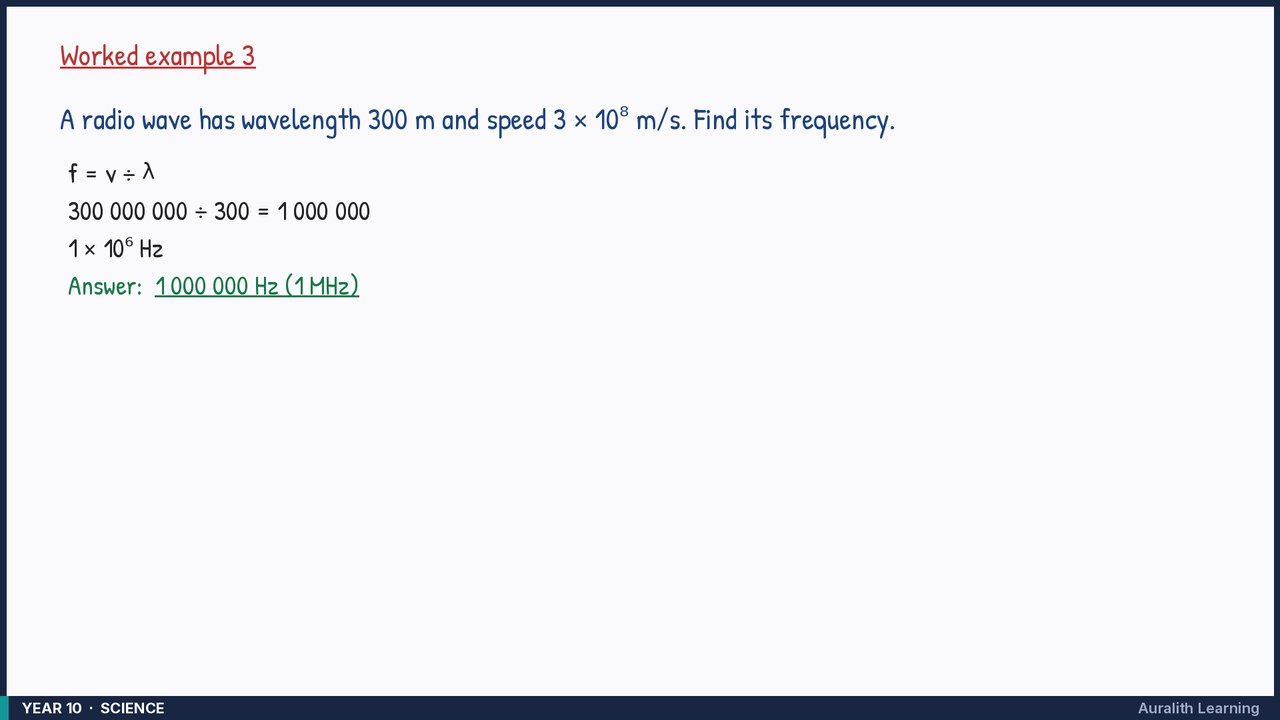
A radio wave has wavelength 300 m and speed 3 × 10⁸ m/s. Find its frequency.
- Step 1: f = v ÷ λ
- Step 2: 300 000 000 ÷ 300 = 1 000 000
- Step 3: 1 × 10⁶ Hz
Answer: 1 000 000 Hz (1 MHz)