Year 10 (ages 14–15, Grade 9 in the US) · Science · Physics: waves and the EM spectrum · Lesson 2
Reflection, refraction and measuring wave speed
How waves reflect and refract at boundaries, why refraction happens when speed changes, and practical methods to measure the speed of sound in air and of ripples on water.
Exam boards: this lesson matches the AQA and Pearson Edexcel GCSE science courses. Check which course your school follows.
9-minute video lesson
Teaching, worked examples and 20 practice questions solved step by step.
Watch free for a monthWhat your child will learn
- Describe reflection and refraction
- Explain refraction using change of speed
- Measure the speed of sound
- Measure the speed of water ripples
The method
- Draw the normal at 90° to the boundary.
- Slower in the new material: bends towards the normal.
- Faster: bends away from the normal.
- Speed = distance ÷ time; measure carefully and repeat.
Key words: reflection, refraction, normal, boundary, echo.
Worked examples
Worked examples from the lesson, with every step.
Question 1
Light hits a mirror at 30° to the normal. What is the angle of reflection?
- Step 1: i = r
- Step 2: 30°
Answer: 30°
Question 2
Light enters a glass block from air. Which way does it bend?
- Step 1: It slows down in glass.
- Step 2: Towards the normal.
Answer: towards the normal
Question 3
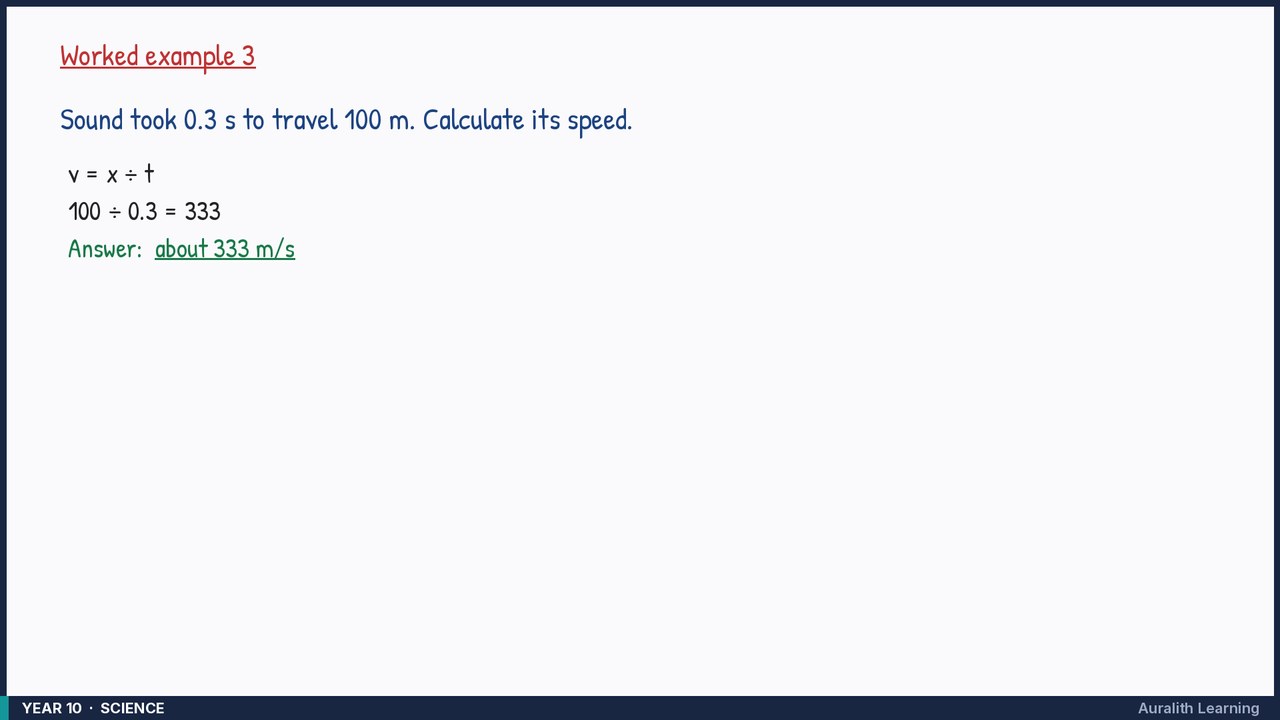
Sound took 0.3 s to travel 100 m. Calculate its speed.
- Step 1: v = x ÷ t
- Step 2: 100 ÷ 0.3 = 333
Answer: about 333 m/s