Year 10 (ages 14–15, Grade 9 in the US) · Science · Physics: radioactivity · Lesson 2
Types of radiation and nuclear equations
Alpha, beta, gamma and neutron radiation: what they are, how ionising and penetrating they are, background radiation, and balancing alpha and beta decay equations.
Exam boards: this lesson matches the AQA and Pearson Edexcel GCSE science courses. Check which course your school follows.
9-minute video lesson
Teaching, worked examples and 20 practice questions solved step by step.
Watch free for a monthWhat your child will learn
- Describe alpha, beta and gamma radiation
- Compare ionising power and penetration
- Explain background radiation
- Balance nuclear decay equations
The method
- Alpha: 2 protons + 2 neutrons; stopped by paper.
- Beta: fast electron from the nucleus; stopped by aluminium.
- Gamma: EM wave; reduced by thick lead or concrete.
- Decay equations: top numbers and bottom numbers must balance.
Key words: alpha, beta, gamma, penetrating, background radiation.
Worked examples
Worked examples from the lesson, with every step.
Question 1
Which radiation is stopped by paper?
- Step 1: Most ionising, least penetrating.
- Step 2: Alpha.
Answer: alpha
Question 2
Radium-226 (atomic number 88) emits an alpha particle. What are the new mass and atomic numbers?
- Step 1: 226 − 4 = 222
- Step 2: 88 − 2 = 86
Answer: mass 222, atomic number 86
Question 3
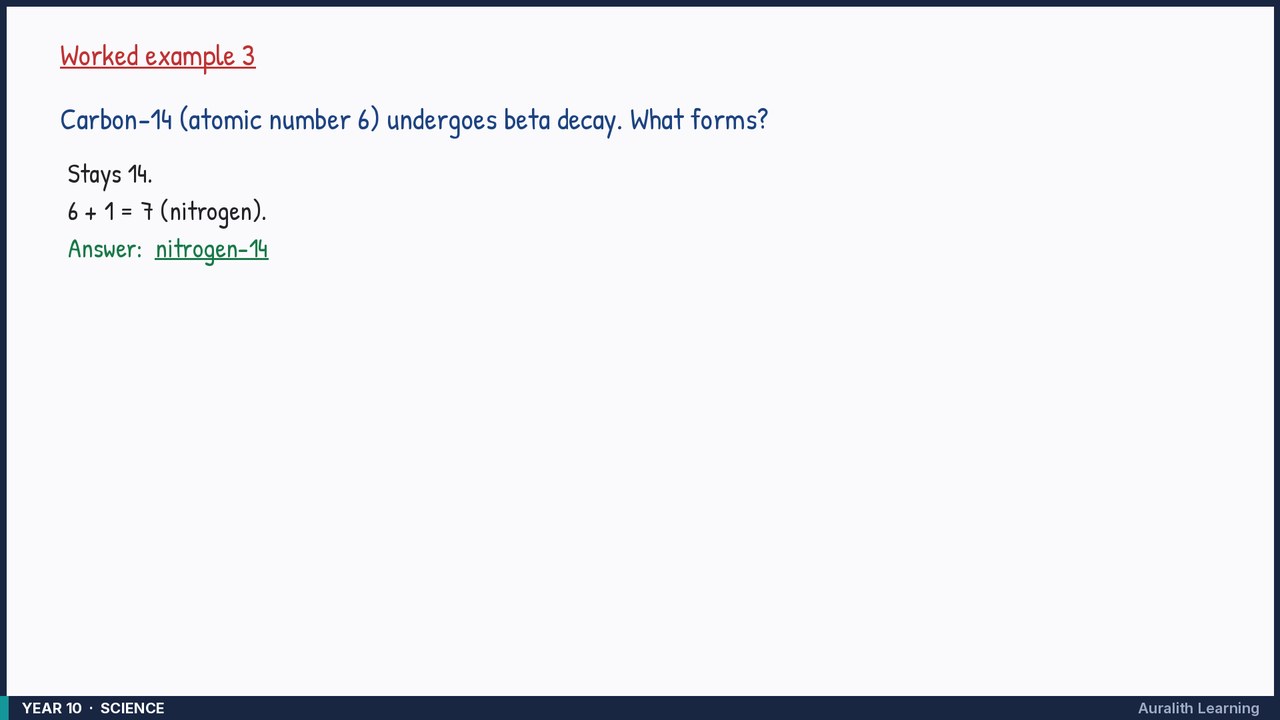
Carbon-14 (atomic number 6) undergoes beta decay. What forms?
- Step 1: Stays 14.
- Step 2: 6 + 1 = 7 (nitrogen).
Answer: nitrogen-14